5 Best Giant Solar System Model Picks for Families (2026)
Find the best giant solar system model for your family or classroom. We compare five picks by size, scale, setup and kid appeal to help you choose.
 By Emily Parker
Updated November 21, 2026
 By Emily Parker
Updated November 2026
A giant solar system model turns the planets into something a child can walk past, touch and measure with their own steps. Whether you want a bright inflatable for a classroom ceiling, a foam-ball kit for a school project, or a precise scale model for a serious young astronomer, the right choice depends on how much space you have, how old the builder is and what you want the model to teach. This guide compares five options across size, build effort, scale accuracy, durability and how well each one suits home or classroom use. Selection is based on manufacturer specifications, brand reputation and common owner feedback patterns rather than any hands-on testing.
Our top picks at a glance
- 1TOP CHOICEBest overallLearning Resources Giant Inflatable Solar SystemView on Amazon
- 2
 TOP CHOICEBest for classrooms with a hands-on buildEISCO Solar System Model, 13"View on Amazon
- 3
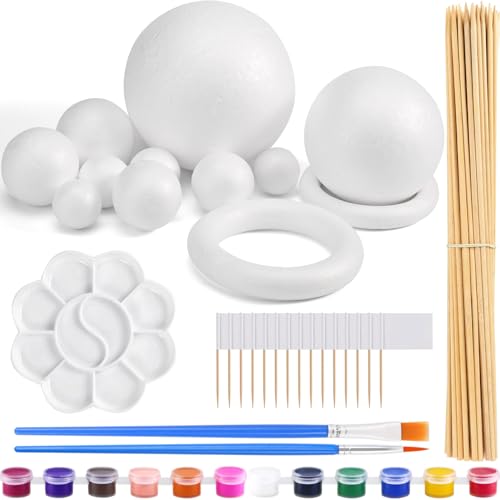 TOP CHOICEBest for school science projects48PCS Solar System Model Foam Ball KitView on Amazon
- 4
 Best for true-to-scale learningAstriFact True Scale Solar System ModelView on Amazon
- 5
 Best budget pickFun Express Inflatable Solar System Model Kit for KidsView on Amazon
Our Top Picks
We ordered these picks by how well they match the most common reasons families and teachers look for a giant solar system model: room to display it, a build that kids can finish, accurate proportions, and a price-to-value balance that makes sense for repeat use.
Quick Comparison
| Product | Best for | Key feature |
|---|---|---|
| Learning Resources Giant Inflatable Solar System | Classrooms and large play areas | Inflatable model that fills a wide floor or hanging space |
| EISCO Solar System Model, 13″ | Desk or shelf display with motion demo | Three-dimensional model showing planet positions and orbits |
| 48PCS Solar System Model Foam Ball Kit | Hands-on school projects | Ten sizes of foam spheres with paint and craft supplies |
| AstriFact True Scale Solar System Model | Scale-minded young astronomers | Planets sized to a 1:2,000,000,000 scale |
| Fun Express Inflatable Solar System Model Kit | Budget-conscious families and classrooms | Ten-piece inflatable kit for quick setup |
Learning Resources Giant Inflatable Solar System
Learning Resources Giant Inflatable Solar System | Project Kit, Space and Planet Model, Constellation Classroom Globe, STEM Science Projects Gifts, Preschool Teacher Must Haves
Best for: Classrooms and large play areas that need a visible, eye-catching display
This inflatable model suits teachers, daycare providers and families who want the solar system to fill a room. Its large size makes it easy for a group of children to see the planets at once, which is useful for group discussion and show-and-tell.
Key specs
- Inflatable design that is large enough to read from across a classroom
- Sold as a project kit with a planet and space theme for STEM lessons
- Designed for indoor display rather than long-term outdoor use
Pros
- Fills a large area quickly and is easy to display from a ceiling or wall
- Bright, recognizable planet graphics that appeal to younger children
- Packs down for storage between lessons or seasons
Cons
- Proportions are designed for visual impact, so it is not a scale model
- Needs an air source or breath to inflate and can lose shape over time
Bottom line: A strong choice for teachers and families who want a big, colorful display for group learning rather than precise measurements.
View on AmazonEISCO Solar System Model, 13″
EISCO Solar System Model, 13" – Three Dimensional – Shows Relative Position and Motion of Planets Around The Sun – Includes Experiment Guide
Best for: Desk or shelf display with a built-in demonstration of planetary motion
This three-dimensional model is aimed at students and parents who want to show how the planets move around the Sun, not just where they sit. The included experiment guide gives a structured way to use the model in a lesson or at home.
Key specs
- Overall display size of about 13 inches, as stated in the product name
- Shows relative position and motion of the planets around the Sun
- Includes an experiment guide for classroom or home use
Pros
- Demonstrates orbital motion, which flat posters cannot do
- Compact enough for a desk, shelf or science lab bench
- The experiment guide gives children something to do with the model
Cons
- At 13 inches it is far smaller than a room-filling display
- Owners often report that the moving parts need gentle handling to stay aligned
Bottom line: A good pick for a classroom science station or a family who wants to show how the planets orbit rather than just how they look.
View on Amazon48PCS Solar System Model Foam Ball Kit
48PCS Solar System Model Foam Ball Kit Includes 10 Sizes Polystyrene Spheres Balls, Bamboo Sticks, Toothpick Flags, 12 Color Pigments, Brushes, Paint Tray Palette for School Science Projects
Best for: Hands-on school projects where the child builds and paints the planets
This kit is built for the classic school project. It includes foam spheres in a range of sizes, along with sticks, flags and paint supplies, so a child can build and color the model from start to finish. It works well for kids who learn by making.
Key specs
- 48 pieces in total, including foam spheres in ten sizes
- Includes bamboo sticks, toothpick flags, paint pigments, brushes and a palette tray
- Intended for school science projects and craft-based learning
Pros
- Everything needed to build and paint the model is in one box
- Ten sphere sizes allow rough size comparison between planets
- Strong option for a project that a child can complete mostly alone
Cons
- Painting takes time and adult supervision for younger children
- Foam spheres are not built to scale, so proportions need a reference chart
Bottom line: The best choice for students who need a physical project to present, especially when the goal is to build something rather than buy something finished.
View on AmazonAstriFact True Scale Solar System Model
AstriFact True Scale Solar System Model, 1:2,000,000,000 Scale Sun & 8 Planet Miniature Display Model, Faithfully Recreated Planet Colors & Details, Astronomy Gift for Science Enthusiasts
Best for: Scale-minded young astronomers who want accurate relative sizes
This model is designed around a stated scale of 1:2,000,000,000, which makes it the most scientifically faithful option in this list. It suits older kids, teens and families who care about how big the planets really are compared with the Sun. For a deeper look, 5 Best Model Solar System Orrery Picks for Family Stargazing (2026) covers this in detail.
Key specs
- Stated scale of 1:2,000,000,000 for the Sun and eight planets
- Planet colors and details recreated to resemble the real planets
- Designed as a display model rather than a play item
Pros
- Accurate relative sizes give a true sense of scale
- Good conversation piece for astronomy fans and gift recipients
- Works well alongside lessons on planetary size and distance
Cons
- At this scale, the inner planets are very small and easy to lose on a shelf
- Less suited to young children who may handle it roughly
Bottom line: The right pick for a family or student who values accuracy and wants a model that teaches true proportions.
View on AmazonFun Express Inflatable Solar System Model Kit for Kids
Fun Express Inflatable Solar System Model Kit for Kids, 10 Piece
Best for: Budget-conscious families and classrooms that want a quick, low-effort display
This ten-piece inflatable kit is a simple way to add a solar system display to a classroom, party or playroom without a large investment of time. It is aimed at younger children and group settings.
Key specs
- Ten-piece inflatable kit for a planetary display
- Designed for indoor use and quick setup
Pros
- Simple setup suitable for busy teachers and parents
- Bright graphics that hold the attention of younger kids
- A practical option when the goal is decoration and basic recognition
Cons
- Limited detail and no scale accuracy compared with science-focused models
- Inflatable pieces can wear out with repeated inflation and storage
Bottom line: A sensible choice when you want a fun, easy display for younger children and do not need scientific precision.
View on AmazonBuying Guide
Before you choose a giant solar system model, think about who will use it, where it will sit and what you want it to teach. The factors below help narrow the field.
Size and display space
Measure the wall, ceiling or shelf before you buy. Inflatable models need enough open floor or hanging room to display their full diameter, while desk models fit on a standard shelf. A room-scale display works for a classroom; a 13-inch model suits a home study.
Good picks for this: Learning Resources Giant Inflatable Solar System, EISCO Solar System Model, 13″
Scale accuracy
Check whether the manufacturer states a scale. A stated ratio, such as 1:2,000,000,000, means the relative sizes of the Sun and planets follow real proportions. Models built for visual appeal may exaggerate size differences, which is fine for play but less useful for measurement lessons.
Good picks for this: AstriFact True Scale Solar System Model, 48PCS Solar System Model Foam Ball Kit
Build effort and age range
Some kits are finished when they arrive, while others take an afternoon or more to paint and assemble. Think about whether the child should build it independently or whether an adult will help. Younger children generally do better with inflatable or pre-assembled options, while older students can handle painting and assembly.
Good picks for this: 48PCS Solar System Model Foam Ball Kit, Fun Express Inflatable Solar System Model Kit for Kids
Use case: classroom, home or event
A classroom model should be visible from the back of the room and easy to store between lessons. A home model may need to fit a shelf or playroom wall and survive daily handling. Party or event decor should be quick to set up and take down. Matching the model to the setting avoids disappointment.
Good picks for this: Learning Resources Giant Inflatable Solar System, EISCO Solar System Model, 13″
Durability and handling
Inflatable models can lose shape or develop leaks, and painted foam can dent. Owners often report that moving parts on desk models need gentle handling. If the model will be handled by young children, look for sturdy construction and plan a safe display height.
Good picks for this: EISCO Solar System Model, 13″, Learning Resources Giant Inflatable Solar System
Educational content and included materials
An experiment guide, labeled planets or paint supplies can turn a model into a lesson. Think about whether you need a reference chart, a teacher guide or just a finished display. Extra materials add value only if you will use them.
Good picks for this: EISCO Solar System Model, 13″, 48PCS Solar System Model Foam Ball Kit
Care and storage
Inflatable models should be deflated and stored flat in a dry place. Painted foam pieces benefit from a shelf away from direct sunlight, which can fade paint. Keeping the original packaging helps protect the parts between uses.
Good picks for this: Fun Express Inflatable Solar System Model Kit for Kids, AstriFact True Scale Solar System Model
For more ideas on how to plan a model build, see Solar System Model Craft: 6 Steps to Build One at Home and Solar System Model on Poster Board: A Step-by-Step Guide for Kids. If you are planning a classroom project with supplies, What Solar System Model Supplies Do You Need for a Classroom Project? covers the basics.
FAQ
How big is a giant solar system model?
Size varies widely. Inflatable models are designed to fill a room or hang from a ceiling, while desk models may be around 13 inches across. Accurate scale models can be much smaller in terms of planet size, because the real distances are enormous and must be scaled down heavily.
Is an inflatable solar system model accurate?
Most inflatable models are built for visual impact rather than scientific accuracy. They are useful for showing the basic order of the planets and for group display, but they should not be used to teach relative sizes unless the manufacturer states a true scale.
What does “true scale” mean for a solar system model?
A true scale model keeps the sizes of the Sun and planets in the same proportion as in reality. Manufacturers usually state the scale as a ratio, such as 1:2,000,000,000. The planets become very small at this ratio, so the model is often better for learning than for display across a large room.
Can young children build a solar system model on their own?
Children aged around 8 and older can often complete a foam-ball or paper project with some help, while younger children usually do better with pre-assembled or inflatable options. Adult supervision is recommended for any project that involves paint, small parts or sharp tools.
How should I store a giant solar system model between uses?
Deflate inflatable models fully and store them flat in a dry place. Keep painted foam pieces on a shelf away from direct sunlight and moisture. Keeping the original packaging helps protect small parts and makes it easier to reuse the model next year.
Where is the best place to display a solar system model at home?
A high shelf, a hallway wall or a ceiling corner works well for most models. Keep the display away from heaters, windows that receive strong sun and areas where small children could pull parts down. Check that any hanging model is secured safely.
Do solar system models need any special maintenance?
Most models need only occasional dusting and gentle handling. Inflatable models may need a quick check for leaks before each use, and moving parts on desk models may need realigning after handling. Follow the manufacturer’s care instructions for best results.
Conclusion
For a large, visible display in a classroom or playroom, the Learning Resources Giant Inflatable Solar System offers the most visual impact. Families who want a model that shows how the planets move should look at the EISCO Solar System Model, 13″. For a hands-on school project where the child builds and paints the planets, the 48PCS Solar System Model Foam Ball Kit is the most practical choice. If accurate proportions matter most, the AstriFact True Scale Solar System Model is the strongest pick, and the Fun Express Inflatable Solar System Model Kit for Kids suits a quick, low-cost display for younger children. Match the model to the space, the builder’s age and the purpose, and any of these five can serve as a useful centerpiece for learning about the solar system.
Sources
- Current planetary facts, sizes and orbital information for teaching the solar system (nasa.gov)
- Museum resources and educational material on space science and planetary models (si.edu)
- Classroom teaching guidance and hands-on science activities for school projects
Related reading
- Why the Model of the Solar System Changed Because of New Evidence
- Why Won't My Solar Power System Working Model Spin? 5 Causes and Fixes
- Who Proposed the Heliocentric Model of the Solar System (2026): Which Should You Choose?
About Emily Parker
Emily Parker is part of our editorial team and reviews and edits our astronomy for kids, teens & families guides, checking product details against manufacturer specifications and owner feedback.
About the author
Emily Parker writes reviews and buying guides for Youth in Astronomy.