Celestron Explorascope 114az Telescope with Basic Smartphone Adapter (2026): Pros, Cons & Verdict
Celestron ExploraScope 114AZ telescope with basic smartphone adapter review: specs, pros and cons, and who it suits best for family stargazing in 2026.
 By Caleb Morgan
Updated November 21, 2026
 By Caleb Morgan
Updated November 2026
The celestron explorascope 114az telescope with basic smartphone adapter is a reflector designed for families and first-time observers who want a simple, portable way to look at the Moon, planets and bright deep-sky objects. It pairs a 114mm aperture with an alt-azimuth mount and a smartphone adapter that holds a phone over the eyepiece for quick photos. This suits parents, grandparents and young astronomers who want to start outdoors without learning complicated setup. It is less suitable for people chasing faint galaxies from light-polluted cities, anyone who needs motorized tracking, or buyers who want a long-term astrophotography platform.
Celestron ExploraScope 22103 114AZ Reflector Telescope with Celestron 81035 Basic Smartphone Adapter 1.25" Capture Your Discoveries, Black
Product Overview
The ExploraScope 114AZ is part of Celestron’s ExploraScope line, which is built around the idea that a telescope should be ready to use in minutes. The optical tube is a Newtonian reflector, meaning it uses a curved primary mirror to gather light and a flat secondary mirror to direct it to the eyepiece. Reflectors of this size are popular with beginners because a 114mm mirror collects far more light than a typical small refractor of similar cost, which helps with brighter deep-sky targets such as the Orion Nebula and star clusters.
The mount is an alt-azimuth design, moving up and down and side to side, similar to a camera tripod head. That makes it intuitive for children, though it does mean the image rotates slowly as Earth turns. Most owners find this easy to live with at low and moderate magnifications. The package is typically marketed as a complete starter kit, including the tube, tripod, eyepieces and the Celestron 81035 Basic Smartphone Adapter designed to clamp a phone to the eyepiece holder.
The product name itself tells you what to expect: a relatively simple reflector aimed at casual viewing rather than serious imaging. If you are looking for a first telescope to share with kids on clear weekends, this is the category it belongs to. If you are looking for something that will grow with an advanced hobbyist, you should compare it with the alternatives discussed later in this review.
Key Features & Specifications
The table below lists specifications that the product name and standard manufacturer information for this model commonly state. Confirm exact figures on the current listing before buying, since packaging can change between production runs.
| Feature | Specification |
|---|---|
| Telescope type | Newtonian reflector |
| Aperture | 114 mm (4.5 inches) |
| Mount | Alt-azimuth (manual) |
| Eyepiece size | 1.25 inch |
| Smartphone adapter | Celestron 81035 Basic Smartphone Adapter |
| Setup | No tools required for basic assembly |
| Color | Black |
| Intended use | Beginner visual astronomy, Moon, planets, bright deep-sky objects |
The 114mm aperture is the most important number here. Light-gathering power scales with the area of the mirror, so this model collects roughly four times as much light as a 60mm refractor, which is why it tends to show more detail on the Moon and brighter nebulae. The 1.25-inch eyepiece size is the standard for entry-level telescopes, so replacement eyepieces and filters are easy to find.
The basic smartphone adapter is a clamp that attaches to the eyepiece holder and holds a phone roughly centered over the eyepiece. It is designed for simple snapshots of the Moon and bright planets. Expect soft, grainy results rather than detailed astrophotos, since phones are not held perfectly steady and the optics are not designed for camera work.
Pros & Cons
Pros
- The 114mm reflector mirror gathers substantially more light than many small refractors, which helps with brighter deep-sky targets.
- The alt-azimuth mount is intuitive for children and adults who have never used a telescope.
- Basic assembly is quick and typically requires no tools, which matters when younger observers want to start right away.
- The 1.25-inch eyepiece standard means accessories such as filters, extra eyepieces and smartphone adapters are widely available.
- The smartphone adapter lets families capture photos of the Moon and planets to share and review later.
- It is a relatively compact package that is practical to carry to a dark-sky site or a park.
Cons
- Manual alt-azimuth mounts require constant nudging to follow objects, which can frustrate younger users.
- Reflectors need occasional collimation (mirror alignment), a task that many beginners find fiddly at first.
- The image is inverted or rotated depending on the eyepiece, which can confuse people who expect a corrected view.
- The basic smartphone adapter is limited; photos are often blurry without careful alignment and a steady hand.
- Light pollution from suburban or city skies will significantly reduce the number of visible deep-sky objects.
- It is not designed for serious astrophotography or long exposures.
Performance Analysis
Performance for this type of telescope depends on three factors: aperture, sky quality and magnification. The 114mm mirror delivers solid views of the Moon at low and medium power. Crater detail, the terminator line between light and shadow, and the rough edges of maria are visible at magnifications that most beginners will find comfortable. Planets such as Jupiter, with its cloud bands and four bright moons, and Saturn, with its rings, are visible as small but recognizable disks. Expect Saturn’s rings to look small and Jupiter’s bands to be subtle unless the sky is steady and transparent.
Deep-sky performance is where expectations need management. Bright targets such as the Orion Nebula, the Pleiades star cluster, and the Andromeda Galaxy’s core are commonly reported as visible from suburban skies, though the nebula and galaxy will appear as faint gray smudges rather than the colorful images seen in photographs. Dark-sky sites make a large difference, and many owners find that moving a few miles from city lights improves the experience more than any accessory upgrade.
Owner feedback patterns for this product line tend to highlight three themes. First, the setup is considered easy, and families often report going from box to first view in under half an hour. Second, the manual mount is seen as a learning tool; it teaches patience and sky navigation, though it can be frustrating for children who want to chase fast-moving objects. Third, the smartphone adapter is considered a nice bonus for sharing views, but expectations for photo quality should stay modest. Use it for quick Moon shots and recognize that stacking software or a dedicated camera will be needed for sharper results.
Collimation is an ongoing maintenance item. Reflectors can drift out of alignment during transport, and the primary and secondary mirrors may need small adjustments with the included or purchased tools. Many owners learn to do this in a few minutes once they see a star test or follow a guide, but parents should plan to set aside time for this the first time.
Who Should Buy This Product?
This telescope is a good match for families with children aged about eight and up who want an introduction to the night sky. It also suits adult beginners who want a telescope that is easy to carry, fast to set up and capable of showing real planetary and lunar detail. Teachers and scout leaders may find it useful for group observing nights, since it can be passed between observers without much training.
You should probably skip this model if your main goal is deep-sky photography, if you live under heavy light pollution and want faint galaxies, or if you want a telescope with computerized object finding. In those cases, a larger aperture, a tracking mount or a GoTo system will serve you better. Very young children may also find the manual mount and eyepiece height frustrating; a smaller, lower-maintenance scope may be more enjoyable for ages five to seven.
Buying Guide
Before buying any beginner telescope, consider where you will observe. Suburban backyards with streetlights are fine for the Moon and planets, but deep-sky objects need darker skies. Check a light pollution map to see what you are working with. Next, think about who will use the scope most. Children who are patient and curious will enjoy a manual mount, while adults who want quick object finding may prefer a GoTo or app-guided system.
Look at the mount type carefully. Alt-azimuth mounts are simpler and cheaper to manufacture, which is why they dominate the entry-level market. Equatorial mounts can track the sky more smoothly for photography but have a steeper learning curve. Check the aperture next: bigger usually means brighter views, though a large telescope on a wobbly tripod can be worse than a smaller one that is steady. Finally, confirm the included accessories, particularly the eyepieces and whether a smartphone adapter is part of the package.
If you are comparing options, these well-known alternatives are often considered in the same category:
- Celestron StarSense Explorer LT 114AZ Newtonian Smartphone Guided Telescope is a similar 114mm reflector that adds smartphone app sky navigation to help locate objects. It can be a good choice if you want guided help finding targets rather than relying on a manual star hop.
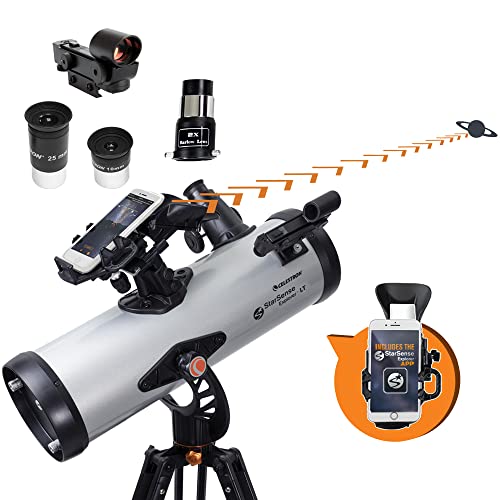
Celestron StarSense Explorer LT 114AZ Newtonian Smartphone Guided Telescope | Smartphone App Sky Navigation, Manual Reflector Telescope, Beginner Deep-Sky Telescope, Bright Celestial Views, Portable
- Celestron ExploraScope 114AZ Relector Manual Telescope for Beginners is a related 114AZ model focused on portable, manual observing with the same general mount approach. Compare the listing details carefully, since packaging and included accessories can differ.

Celestron ExploraScope 114AZ Relector Manual Telescope for Beginners | Portable Reflector Telescope, Bright Moon & Deep-Sky Views, Smooth Alt-Azimuth Controls, Lightweight Tripod, No-Tool Setup
For more setup help and comparisons, you may find these guides useful: Celestron Moon Mission 114az-sr Reflector Telescope with Smartphone Adapter: A Practical Guide (2026), Smartphone Adapter for Celestron Telescope: A Step-by-Step Setup Guide, and Celestron Powerseeker 80azs Telescope with Basic Smartphone Adapter Black (2026): Pros, Cons & Verdict. Readers choosing between a reflector and a refractor may also want Celestron Omni AZ 102 Telescope with Smartphone Adapter Review: Is It Worth It? for a comparison of a different aperture class.
FAQ
Is the Celestron ExploraScope 114AZ good for complete beginners?
Yes, for most beginners it is a reasonable first telescope. The alt-azimuth mount and minimal setup make it approachable, and the 114mm aperture gives satisfying views of the Moon and planets. Expect a short learning curve for finding objects with a manual mount.
Can I see planets with this telescope?
You can see Jupiter’s largest cloud bands and its four bright moons, as well as Saturn’s rings as a small disk. Mars and Venus show up as small discs or phases. Detail depends on atmospheric steadiness and your magnification, so expect modest rather than dramatic planetary views.
How does the basic smartphone adapter work?
The adapter clamps your phone over the eyepiece so the camera looks through the telescope. Align the phone’s lens with the eyepiece center, use the camera’s zoom or the highest-quality setting, and take multiple shots. Results are best on the Moon and bright planets.
Do I need to collimate the mirrors?
Periodic collimation is normal for Newtonian reflectors. Many owners check alignment before each session, especially after moving the telescope. It is a learnable skill, and the process usually takes a few minutes once you understand the adjustment screws.
Will this telescope work in a city?
It will show the Moon, planets and some bright star clusters from light-polluted areas. Faint nebulae and galaxies are much harder to see from cities. A dark-sky site dramatically improves what you can observe with any telescope of this size.
Is this suitable for children?
Children around eight and older usually handle it well, especially with adult help for setup and object finding. Younger children may find the manual mount and eyepiece height challenging, though supervised use can still be enjoyable.
Can I use this for astrophotography?
The smartphone adapter supports casual snapshots, but this is not a dedicated astrophotography system. Long exposures and tracking would require a different mount and camera setup. Treat photos as fun souvenirs rather than publication-quality images.
Should I buy this or a telescope with GoTo?
If you want to learn the sky and enjoy hands-on navigation, the manual ExploraScope is a good teacher. If you want the telescope to find objects for you, a GoTo model will save time but usually costs more and has more to set up. Your choice depends on patience and goals.
Final Verdict
Recommended for families who want a simple, portable reflector
The celestron explorascope 114az telescope with basic smartphone adapter is a sensible starter telescope for families and beginners who want good lunar and planetary views with minimal fuss. Its 114mm reflector mirror gathers more light than many entry-level refractors, and the manual alt-azimuth mount teaches the basics of sky navigation. The smartphone adapter is a pleasant extra for capturing moments to share, though expectations for photo quality should stay realistic. Skip it if you need a tracking mount, serious astrophotography capability, or deep-sky performance from a light-polluted backyard. For everyone else, it offers a straightforward path into observing the night sky.
View on AmazonRelated reading
About Caleb Morgan
Caleb Morgan is part of our editorial team and reviews and edits our astronomy for kids, teens & families guides, checking product details against manufacturer specifications and owner feedback.
About the author
Caleb Morgan writes reviews and buying guides for Youth in Astronomy.