5 Best Dobsonian Telescope GoTo Kits of 2026 for Beginners
Compare the best dobsonian telescope goto kit options for beginners. See our five picks, key specs, pros and cons, and a buying guide to help you choose.
 By Owen Palmer
Updated November 24, 2026
 By Owen Palmer
Updated November 2026
A dobsonian telescope goto kit gives beginners a large light-gathering mirror on a simple, sturdy base, plus a computerized mount that finds planets, star clusters and galaxies for you. If you want to see deep-sky objects without spending a long evening hunting with a star chart, this type of setup is one of the most practical choices. The picks below were compared on aperture, mount type, setup effort, portability, and the patterns owners tend to report, so you can match a kit to your backyard, your space and your patience.
Our top picks at a glance
- 1TOP CHOICEBest overallSky-Watcher Classic 200 Dobsonian 8-inch TelescopeView on Amazon
- 2
 TOP CHOICEBest for larger deep-sky viewsSky Watcher Classic 250 Dobsonian 10-inch TelescopeView on Amazon
- 3
 TOP CHOICEBest for small spacesCelestron StarSense Explorer 114AZ App-Enabled Tabletop Dobsonian TelescopeView on Amazon
- 4
 Best budget pickCelestron FirstScope Signature Series Moon Tabletop Dobsonian TelescopeView on Amazon
- 5
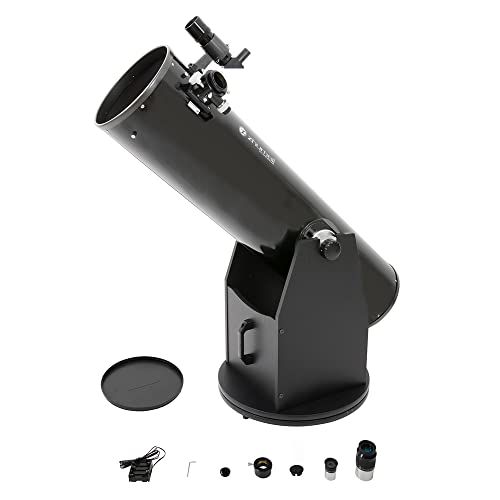 Best for serious backyard observingZhumell 10-inch Dobsonian Reflector TelescopeView on Amazon
Our Top Picks
Each pick below is a dobsonian-style reflector. The “goto” part means the mount can be aligned and then pointed at thousands of objects automatically. Where a model is sold as a manual scope, we say so, because a manual version is still a useful first telescope. Owners often describe the trade-off in similar terms: more aperture gives brighter, more detailed views, but a larger tube is harder to carry out and set up.
Quick Comparison
| Product | Best for | Key feature |
|---|---|---|
| Sky-Watcher Classic 200 Dobsonian 8-inch Telescope | Beginners who want a balanced first large telescope | 8-inch solid-tube reflector on a simple alt-azimuth base |
| Sky Watcher Classic 250 Dobsonian 10-inch Telescope | Observers who want more light for faint objects | 10-inch aperture for brighter deep-sky views |
| Celestron StarSense Explorer 114AZ App-Enabled Tabletop Dobsonian Telescope | Families and small rooms or balconies | Smartphone app guides alignment and star finding |
| Celestron FirstScope Signature Series Moon Tabletop Dobsonian Telescope | Kids and first-time observers on a tight budget | Compact manual tabletop design with a lunar map wrap |
| Zhumell 10-inch Dobsonian Reflector Telescope | Experienced beginners who want the largest aperture here | 10-inch aperture with a handle for easier transport |
Sky-Watcher Classic 200 Dobsonian 8-inch Telescope
Sky-Watcher Classic 200 Dobsonian 8-inch Telescope – Solid-Tube – Simple, Traditional Design – Easy to Use, Perfect for Beginners, White (S11610)
Best for: Beginners who want a balanced first large telescope
This is a good fit for someone who wants a real step up from a small refractor, enjoys a traditional design, and has space in a garage, shed or spare room. It rewards a little patience with setup and star-hopping, which many new observers find satisfying.
Key specs
- 8-inch (200mm) reflector aperture
- Solid-tube Dobsonian design on a simple altitude-azimuth base
Pros
- Large aperture gathers far more light than typical starter scopes
- Simple, traditional mechanics are easy to understand and maintain
- Good balance between views and portability for a Dobsonian
Cons
- Manual tracking means you must nudge the telescope to keep objects centered
- The tube is bulky to carry outdoors and needs a flat, stable spot
Bottom line: A strong choice for a beginner who wants serious aperture and is willing to learn star-hopping. Less ideal for anyone who wants automatic pointing.
View on AmazonSky Watcher Classic 250 Dobsonian 10-inch Telescope
Sky Watcher Sky-Watcher Classic 250 Dobsonian 10-inch Telescope – Solid-Tube – Simple, Traditional Design – Easy to Use, Perfect for Beginners (S11620)
Best for: Observers who want more light for faint objects
This model suits people who already know they enjoy observing, have a dark sky within driving distance, and want to see fainter galaxies and nebulae. The extra aperture is the main reason to choose it.
Key specs
- 10-inch (250mm) reflector aperture
- Solid-tube Dobsonian design with a simple base
Pros
- Substantially more light than an 8-inch scope for deep-sky targets
- Traditional, easy-to-service design
- Well suited to a dedicated observing spot at home
Cons
- Heavy and awkward to move, especially for younger users
- Requires good collimation habits and occasional tuning
Bottom line: The right pick for a motivated beginner who can store a larger scope and wants the most light from this list.
View on AmazonCelestron StarSense Explorer 114AZ App-Enabled Tabletop Dobsonian Telescope
Celestron StarSense Explorer 114AZ App-Enabled Tabletop Dobsonian Telescope | 114mm Tabletop Dobsonian, Smartphone Dock, App, IPhone, Android Compatible
Best for: Families and small rooms or balconies
A smartphone dock and app do the star-finding work, which makes this a practical choice for families or anyone who wants quick results without learning the sky first. Its tabletop size keeps setup simple.
Key specs
- 114mm reflector aperture
- Tabletop Dobsonian base with smartphone dock
- Works with iPhone and Android through the companion app
Pros
- App-based alignment makes finding objects far easier for newcomers
- Compact and light enough for a table, windowsill or patio
- Good entry point for kids and adults sharing one scope
Cons
- Smaller aperture limits faint deep-sky detail compared with 8- or 10-inch scopes
- Depends on phone battery and app compatibility, which can change over time
Bottom line: Best for people who want the easiest path to finding objects and have limited space. Not ideal if you want the largest possible views.
View on AmazonCelestron FirstScope Signature Series Moon Tabletop Dobsonian Telescope
Celestron FirstScope Signature Series Moon Tabletop Dobsonian Telescope | Manual Tabletop Dobsonian Telescope with Moon Map Wrap, Great for Beginners, Compact & Portable, Includes Lunar eBook
Best for: Kids and first-time observers on a tight budget
This is a manual tabletop scope with a lunar map included, aimed at curious beginners who want to see the Moon, bright planets and a few easy targets without a large investment or setup routine.
Key specs
- Compact tabletop Dobsonian design
- Includes a moon map wrap and a lunar eBook
Pros
- Very portable and quick to set up on a table or step stool
- Good first-scope experience for children and families
- Included Moon map adds educational value
Cons
- Small aperture limits views of faint galaxies and nebulae
- Manual operation only, with no computerized goto
Bottom line: A low-friction way to start, especially for kids. Upgrade later if you find yourself wanting deep-sky targets.
View on AmazonZhumell 10-inch Dobsonian Reflector Telescope
Zhumell – 10-inch Dobsonian Reflector Telescope – Large Aperture for Crisp, Bright Images – Solid Base Construction with Handle for Easy Transport – Ideal Astronomical Telescope
Best for: Experienced beginners who want the largest aperture here
This 10-inch reflector is a strong option for someone who has already used a smaller telescope and wants brighter, more detailed deep-sky views. A built-in handle helps with transport, though the scope is still substantial.
Key specs
- 10-inch reflector aperture
- Dobsonian base with a carry handle
Pros
- Large aperture for bright, detailed deep-sky views
- Handle makes it easier to carry from storage to the yard
- Solid base construction supports stable viewing
Cons
- Large, heavy tube requires dedicated storage space
- Manual pointing with no built-in goto, so star-hopping skills help
Bottom line: A good match for a committed beginner with a dark-sky site and the space to store a big scope.
View on AmazonBuying Guide
Aperture and light-gathering power
Aperture, the diameter of the main mirror, is the single most important number for a dobsonian. Larger apertures collect more light, which shows fainter galaxies and more detail in nebulae. Going from 8 inches to 10 inches increases light-gathering area by roughly 56 percent, which is why many observers consider aperture the first thing to prioritize.
Good picks for this: Sky Watcher Classic 250 Dobsonian 10-inch Telescope, Zhumell 10-inch Dobsonian Reflector Telescope
Goto versus manual mounts
A goto mount uses motors and an internal database to point the telescope at chosen objects. A manual mount relies on you finding targets with a finder scope and star charts. Goto is helpful for quick results, while manual mounts teach you the sky. Consider which style you will enjoy using most.
Good picks for this: Celestron StarSense Explorer 114AZ App-Enabled Tabletop Dobsonian Telescope, Celestron FirstScope Signature Series Moon Tabletop Dobsonian Telescope
Size, weight and portability
A dobsonian’s tube is the heaviest part, and a 10-inch model can be much harder to move than an 8-inch or a tabletop scope. Measure your storage space and the route from storage to your observing spot. If you must carry the scope down stairs or across grass, a tabletop model may be more realistic.
Good picks for this: Celestron FirstScope Signature Series Moon Tabletop Dobsonian Telescope, Sky-Watcher Classic 200 Dobsonian 8-inch Telescope
Setup and alignment effort
Some kits need a few minutes of alignment on a clear night, while others ask you to learn collimation and star-hopping over several sessions. Think about how much time you want to spend on setup before the first view. Owners who want fast results often prefer app-guided alignment.
Good picks for this: Celestron StarSense Explorer 114AZ App-Enabled Tabletop Dobsonian Telescope, Sky-Watcher Classic 200 Dobsonian 8-inch Telescope
Intended use case
Think about what you want to see. Planets and the Moon need less aperture and can be viewed from a bright backyard. Faint deep-sky objects need darker skies and more aperture. Matching the scope to your typical viewing location is more useful than buying the largest scope you can afford.
Good picks for this: Zhumell 10-inch Dobsonian Reflector Telescope, Sky Watcher Classic 250 Dobsonian 10-inch Telescope
Durability and build quality
Look for a sturdy base, smooth altitude and azimuth motion, and a tube that holds its shape. Solid-tube Dobsonians are traditionally simple, which many owners find reliable over time. Check that accessories such as eyepieces and finder scopes are included and of usable quality.
Good picks for this: Sky-Watcher Classic 200 Dobsonian 8-inch Telescope, Zhumell 10-inch Dobsonian Reflector Telescope
Care, collimation and maintenance
Mirrors need occasional collimation, which is the alignment of the optics. Store the telescope in a dry place, cover the optics when not in use, and let it reach outdoor temperature before observing to reduce fogging and image shimmer. For major repairs or mirror cleaning, consult a qualified telescope technician.
Good picks for this: Sky Watcher Classic 250 Dobsonian 10-inch Telescope, Celestron FirstScope Signature Series Moon Tabletop Dobsonian Telescope
FAQ
What is a dobsonian telescope goto kit?
It is a reflector telescope on a Dobsonian-style base that includes a computerized or app-guided mount able to locate objects automatically after alignment. The optical tube and mount are usually sold together, though some setups are assembled from separate parts.
Is aperture more important than goto?
For most observers, aperture matters more for the quality of views, while goto matters more for convenience. A large manual scope can show more detail than a small goto scope, but a goto scope may keep beginners observing longer because it is easier to use.
Do I need a dark sky to enjoy a dobsonian?
Not for the Moon, planets, double stars and bright clusters, which work well from many suburban backyards. Faint galaxies and nebulae benefit greatly from darker skies, so a trip to a rural site can make a big difference.
How long does setup take?
Many beginners need 15 to 30 minutes for their first setup, including assembly and alignment. The time drops with practice. App-guided models often align faster than manual scopes.
Can children use these telescopes?
Yes, especially tabletop models with simple controls. Adult supervision helps with carrying, setup and safe handling. Never point any telescope at the Sun without a proper solar filter, because direct sunlight can cause permanent eye damage. Consult a professional astronomy club or instructor if you are unsure about solar observing.
Should I buy eyepieces separately?
Many kits include basic eyepieces, but owners often find that an upgrade to a wider-field or higher-magnification eyepiece improves the experience. Check what is included before you buy extras.
Conclusion
For most beginners, the Sky-Watcher Classic 200 Dobsonian 8-inch Telescope offers a balanced first large scope with real aperture and simple mechanics. If you have space and want more light, the Sky Watcher Classic 250 Dobsonian 10-inch Telescope or the Zhumell 10-inch Dobsonian Reflector Telescope are better fits. Families and people with small spaces may prefer the Celestron StarSense Explorer 114AZ App-Enabled Tabletop Dobsonian Telescope, and kids or tight budgets may start with the Celestron FirstScope Signature Series Moon Tabletop Dobsonian Telescope. Match the scope to your storage space, observing location and how much you want the computer to do for you.
Sources
- Background on telescopes, the Moon and planets for beginners (nasa.gov)
- Resources for amateur observers, including local clubs and observing guides
- Safety guidance for young users and product handling (cpsc.gov)
Before you buy: helpful guides
- 10 Inch Dobsonian Telescope Kit: 5 Steps to Your First Night Under the Stars
- Dobsonian Telescope Kits for Sale: 5 Things to Check Before You Buy (2026)
- Orion SkyQuest XT8 Classic Dobsonian Telescope Kit: Setup and First-Night Guide
- Orion SkyQuest XT6 Classic Dobsonian Telescope Kit: Setup Steps for Beginners
Related reading
- 5 Best Dobsonian Telescope GoTo Mount Options for Beginners (2026)
- Sky-Watcher 12 GoTo Collapsible Dobsonian Telescope Review: Is It Worth It?
- Dobsonian Telescope with GoTo: 6 Best Picks Compared for 2026
About Owen Palmer
Owen Palmer is part of our editorial team and reviews and edits our astronomy for kids, teens & families guides, checking product details against manufacturer specifications and owner feedback.
About the author
Owen Palmer writes reviews and buying guides for Youth in Astronomy.