Christmas Telescope for Kids Ideas: 5 Best Picks for Young Stargazers
Looking for a christmas telescope for kids ideas? Compare five beginner-friendly picks by setup, magnification, and portability to find the right holiday gift.
 By Caleb Morgan
Updated November 25, 2026
 By Caleb Morgan
Updated November 2026
Choosing a christmas telescope for kids ideas list starts with one question: what will the child actually do with it? A telescope that looks impressive in a box can frustrate a young stargazer if it is hard to aim, too shaky to hold steady, or better suited to adults. This guide compares five gift-ready options by how easy they are to set up, how much they show at a beginner’s magnification, how portable they are, and whether the included accessories suit children roughly between the ages of 6 and 12. We looked at manufacturer specifications, brand reputation, and the patterns that appear in owner feedback, including common complaints about wobbly mounts and overly high magnification claims.
Our top picks at a glance
- 1TOP CHOICEBest overallGskyer Telescope, 70mm Aperture 400mm AZ Mount Astronomical RefractingView on Amazon
- 2
 TOP CHOICEBest for Moon viewingNASA Lunar Telescope for Kids Ages 8-12 with Tripod and Finder ScopeView on Amazon
- 3
 TOP CHOICEBest budget pickTelescope for Kids, 50mm 100x Beginner Telescope with TripodView on Amazon
- 4
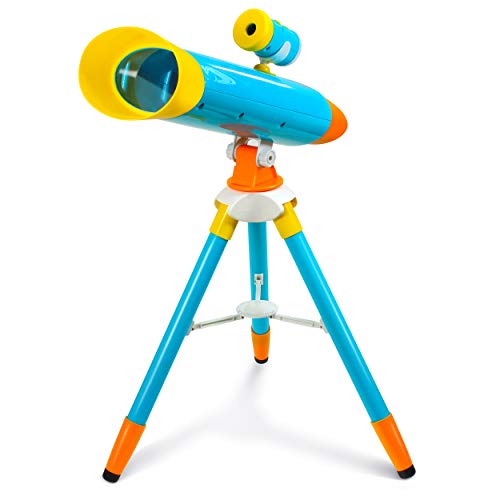 Best for younger childrenLittle Experimenter Projector Telescope, 24 Space Images, STEM Kids 3-12View on Amazon
- 5
 Best for portable family useTelescope for Kids, Space Toys for Kids Includes Compass and 3 EyepiecesView on Amazon
Our Top Picks
Quick Comparison
| Product | Best for | Key feature |
|---|---|---|
| Gskyer 70mm Aperture 400mm Refractor | Overall family use and travel | 70mm aperture with carry bag and phone adapter |
| NASA Lunar Telescope for Kids | Moon and bright-object viewing | Tabletop tripod and two eyepieces |
| 50mm 100x Beginner Telescope with Tripod | Budget-minded gift buyers | Finder scope and two eyepieces |
| Little Experimenter Projector Telescope | Younger children, ages 3 and up | Projects 24 space images, no eyepiece skills needed |
| Telescope for Kids with Compass and 3 Eyepieces | Portable use and first-time observers | Compass plus three eyepieces for varied magnification |
Best High Powered Telescope for Kids: What Matters Most (2026) explains why higher magnification numbers rarely mean a better view, which is worth reading before comparing listings.
Gskyer Telescope, 70mm Aperture 400mm AZ Mount Astronomical Refracting Telescope for Kids Beginners
Gskyer Telescope, 70mm Aperture 400mm AZ Mount Astronomical Refracting Telescope for Kids Beginners – Travel Telescope with Carry Bag, Phone Adapter and Wireless Remote.
Best for: Overall family use and travel
This refractor suits a child who is ready to take a telescope outdoors regularly and who has a parent willing to help with setup for the first few sessions. The 70mm aperture is larger than most toy-style telescopes, which means more light gathering for the Moon, bright planets, and brighter star clusters.
Key specs
- 70mm objective aperture
- 400mm focal length (per listing name)
- AZ (altazimuth) mount
- Includes carry bag, phone adapter, and wireless remote
Pros
- Larger aperture than many starter models, so planets and the Moon look clearer
- Carry bag makes it practical for car trips and camping
- Phone adapter lets older kids photograph what they see
Cons
- Setup takes a few minutes and benefits from an adult’s help
- Small AZ mounts can drift when a child bumps the tube
Bottom line: A strong choice for a family that wants one telescope to use at home and on trips, especially for children ages 8 and up with an adult nearby.
View on AmazonNASA Lunar Telescope for Kids Ages 8-12 with Tripod and Finder Scope
NASA Lunar Telescope for Kids Ages 8-12 with Tripod and Finder Scope | 90x Magnification, Two Eyepieces, Tabletop Tripod, Beginner Astronomy, Space Toys, NASA Birthday Gift
Best for: Moon and bright-object viewing
This tabletop-style telescope is built around the Moon, which is the object most beginners find first and enjoy most. It is a good match for a child who is curious about lunar craters and wants a gift that feels like a real science kit.
Key specs
- Tabletop tripod included
- Finder scope for easier aiming
- Two eyepieces (per listing)
- Marketed for ages 8 to 12
Pros
- Finder scope simplifies locating targets
- Tabletop tripod is easy to move between a table and a window
- Designed around the Moon, a reliable first target
Cons
- Tabletop tripods are less steady outdoors than a full floor tripod
- Limited for deep-sky objects beyond the Moon and bright planets
Bottom line: Best for a child who will mostly watch the Moon and wants a simple, themed gift with a clear first target.
View on AmazonTelescope for Kids, 50mm 100x Beginner Telescope with Tripod
Telescope for Kids, 50mm 100x Beginner Telescope with Tripod | 2 Eyepieces, Finder Scope, Hands-On STEM Learning, Space Exploration Fun, Educational Toy Gift for Boys & Girls Ages 6-12
Best for: Budget-minded gift buyers
This model is aimed at families who want a complete starter kit without spending heavily. It fits a child who is just starting to explore the night sky and who will be happy with the Moon and bright planets at first.
Key specs
- 50mm objective aperture (per listing)
- Tripod included
- Two eyepieces and a finder scope
Pros
- Includes a tripod, eyepieces, and finder scope in one box
- Simple enough for a child to operate with minimal help
- Good entry point for a first telescope
Cons
- The advertised 100x magnification is harder to use well; lower powers give sharper images
- Budget tripods can wobble in wind
Bottom line: A sensible choice for a first telescope when the goal is to build interest without a large commitment.
View on AmazonLittle Experimenter Projector Telescope, 24 Space Images, STEM Kids 3-12
Little Experimenter Projector Telescope, 24 Space Images, STEM Kids 3-12 | STEM Science Toy, Learning Gift for Boys & Girls Ages 3-12
Best for: Younger children, ages 3 and up
This is not a traditional optical telescope. It is a projector-style STEM toy that shows space images, which makes it a good fit for a younger child who is not yet ready for a real observing session. It works well as a bridge between a picture book and a true telescope.
Key specs
- Includes 24 space images (per listing)
- Marketed for ages 3 to 12
- STEM learning toy format
Pros
- No setup, focusing, or outdoor darkness needed
- Easy for very young children to use independently
- Introduces planets and space vocabulary
Cons
- It does not show the real night sky
- Older children may outgrow it quickly
Bottom line: Ideal for a preschool or early-elementary child who loves space pictures. Pair it with a real telescope later if interest grows.
View on AmazonTelescope for Kids, Space Toys for Kids Includes Compass and 3 Eyepieces
Telescope for Kids, Space Toys for Kids Includes Compass & 3 Eyepieces, Great Portable Telescope as Astronomy Gifts, Educational STEM Kit for Boys and Girls to See Moon
Best for: Portable use and first-time observers
This kit targets children who want to carry a telescope to a yard, park, or campsite and experiment with different magnifications. The compass adds a navigation element that suits families who like combining astronomy with outdoor activities.
Key specs
- Three eyepieces (per listing)
- Built-in compass
- Designed as a portable educational kit
Pros
- Three eyepieces let a child compare views at different powers
- Compact enough to carry on short trips
- Compass supports learning about direction and the sky
Cons
- Small aperture limits faint-object viewing
- Accessories can be lost if not stored in the case
Bottom line: A good pick for a child who wants a portable telescope for backyard and park trips, with room to explore several eyepieces.
View on AmazonBuying Guide
Aperture and Light-Gathering
Aperture, the diameter of the main lens or mirror, matters more than magnification. A larger opening collects more light, which means brighter and sharper views of the Moon and planets. Many beginner telescopes list aperture in millimeters; a 50mm to 70mm refractor is a common range for children.
Good picks for this: Gskyer Telescope 70mm Aperture 400mm AZ Mount, Telescope for Kids 50mm 100x Beginner Telescope
Magnification Claims
Large magnification numbers are often used in marketing. Practically, useful magnification is limited by aperture and atmosphere; very high powers make images dim and blurry. Look for a telescope that offers a low-power eyepiece for wide views and a moderate-power one for detail.
Good picks for this: Telescope for Kids with Compass and 3 Eyepieces, NASA Lunar Telescope for Kids
Mount and Stability
A wobbly mount frustrates children more than anything else. Tabletop tripods work for the Moon, but a full-height tripod or sturdy AZ mount is better for longer sessions. Check whether the tripod is included and whether it extends to a comfortable height for a child.
Good picks for this: Gskyer Telescope 70mm Aperture 400mm AZ Mount, NASA Lunar Telescope for Kids Ages 8-12
Finder Scope and Ease of Aiming
A finder scope or red-dot aid helps a child locate targets before looking through the eyepiece. Without one, many beginners spend an entire evening searching. This feature is especially useful for kids under 10.
Good picks for this: NASA Lunar Telescope for Kids Ages 8-12, Telescope for Kids 50mm 100x Beginner Telescope
Age Appropriateness
Children under about 6 often do better with projector toys or picture-based STEM kits. Ages 8 and up can handle a real optical instrument with some adult help. Matching the product to the child’s attention span avoids disappointment on both sides.
Good picks for this: Little Experimenter Projector Telescope, Telescope for Kids with Compass and 3 Eyepieces
Portability and Storage
If the telescope will be carried to a yard, park, or trip, weight and included cases matter. Carry bags and compact accessory storage reduce the chance of lost eyepieces. Families who observe mainly from a window can prioritize a tabletop design instead.
Good picks for this: Gskyer Telescope 70mm Aperture 400mm AZ Mount, Telescope for Kids with Compass and 3 Eyepieces
Durability and Care
Plastic focusers and thin tripod legs are common failure points. Keep eyepieces capped, store the telescope indoors, and avoid pointing any telescope at the Sun without proper solar filters, since looking at the Sun through an optical instrument can cause permanent eye damage. For specific safety guidance, consult a qualified astronomy educator or your local astronomy club.
Good picks for this: NASA Lunar Telescope for Kids Ages 8-12, Telescope for Kids 50mm 100x Beginner Telescope
FAQ
What age is a telescope good for a child?
Most refractor-style telescopes are best for children around 8 and up, who can focus and follow simple setup steps. Younger children, roughly ages 3 to 7, often enjoy projector-style STEM toys more.
Is 100x magnification good for a kids’ telescope?
It is usable, but image quality drops at high powers, especially with small apertures. Lower magnifications usually give a brighter and clearer view for beginners.
Can a kids’ telescope see planets?
Bright planets such as Jupiter and Saturn are often visible as small disks or rings with a modest telescope, though detail will be limited. The Moon is the most rewarding first target.
Do I need a tripod included?
A tripod is essential for steady viewing. If the box does not include one, a separate tripod with a compatible mount will be needed before the telescope is useful.
Should I buy a telescope or a projector toy?
A projector toy suits very young children and quick indoor play. A telescope suits children ready for outdoor observing and longer sessions. Some families start with a toy and move up.
Is it safe for kids to use a telescope unsupervised?
Children should never point any telescope at the Sun without a proper solar filter, as direct sunlight through an optical instrument can cause serious eye injury. Adult supervision is recommended for setup and for any daytime use. For specific guidance, consult an astronomy educator or local club.
Conclusion
For most families, the Gskyer 70mm refractor offers the most complete combination of aperture, portability, and accessories. The NASA Lunar Telescope suits a child who wants a themed Moon-watching gift, while the 50mm beginner kit fits a tighter budget. The Little Experimenter projector works best for younger children, and the compass-and-eyepiece kit suits kids who want to carry a telescope outdoors. Match the choice to the child’s age, patience, and where they will observe most often.
Sources
- Lunar and planetary observing resources, including Moon phases and viewing guides for beginners (nasa.gov)
- Educational materials on telescope types, aperture, and night-sky observing for students
- Consumer safety guidance on toys and children's products, including age labeling (cpsc.gov)
Before you buy: helpful guides
- Kids Telescope Christmas Gift Hallmark Movie: What Parents Should Know
- Kids Telescope Christmas Gift Hallmark: A Parent's Buying Guide
- Christmas Telescope for Kids Tutorial: Set Up and Stargaze This Holiday
- Christmas Telescope for Kids Set: How to Choose a Good Holiday Gift
- Christmas Telescope for Kids Printable: A Step-by-Step Holiday Guide
Related reading
About Caleb Morgan
Caleb Morgan is part of our editorial team and reviews and edits our astronomy for kids, teens & families guides, checking product details against manufacturer specifications and owner feedback.
About the author
Caleb Morgan writes reviews and buying guides for Youth in Astronomy.