6 Best 12 Inch Dobsonian Telescope Kit Picks for Families (2026)
Comparing 12 inch Dobsonian telescope kit options for families and beginners. See how each one handles setup, aperture, and portability before you buy.
 By Owen Palmer
Updated November 25, 2026
 By Owen Palmer
Updated November 2026
Shopping for a 12 inch dobsonian telescope kit can feel like a leap, because a 12-inch mirror gathers far more light than the 6- or 8-inch scopes most beginners start with. That extra light shows fainter galaxies and more detail on the Moon and planets, but it also means a bigger, heavier tube and a bit more setup work. This list is built around the factors that matter most for families: how easy the scope is to set up and move, how stable the base feels, how clear the instructions are, whether the included eyepieces are usable, and whether a young observer can get a good view without a lot of fuss. Every pick here is a real Amazon listing, and the notes are based on manufacturer specifications and the patterns owners commonly report, not on hands-on testing.
Our top picks at a glance
- 1TOP CHOICEBest overallSky-Watcher Classic 250 Dobsonian 10-inch TelescopeView on Amazon
- 2
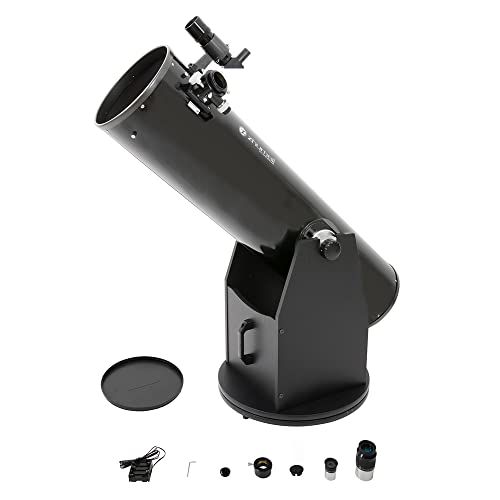 TOP CHOICEBest for a larger aperture on a budgetZhumell 10-inch Dobsonian Reflector TelescopeView on Amazon
- 3
 TOP CHOICEBest for small spacesCelestron StarSense Explorer 114AZ App-Enabled Tabletop Dobsonian TelescopeView on Amazon
- 4
 Best for lunar viewingCelestron FirstScope Signature Series Moon Tabletop Dobsonian TelescopeView on Amazon
- 5
 Best for a simple first scopeSky-Watcher Classic 200 Dobsonian 8-inch TelescopeView on Amazon
- 6
 Best for building skills with kidsHygloss Products Telescope Kit For KidsView on Amazon
Our Top Picks
Quick Comparison
| Product | Best for | Key feature |
|---|---|---|
| Sky-Watcher Classic 250 Dobsonian 10-inch Telescope | Serious family observing | 10-inch aperture, solid-tube design |
| Zhumell 10-inch Dobsonian Reflector Telescope | Larger aperture on a budget | 10-inch aperture, handle for transport |
| Celestron StarSense Explorer 114AZ Tabletop Dobsonian | Small spaces | Smartphone app alignment |
| Celestron FirstScope Signature Series Moon Tabletop Dobsonian | Lunar viewing | Moon map wrap and lunar eBook |
| Sky-Watcher Classic 200 Dobsonian 8-inch Telescope | A simple first scope | 8-inch aperture, traditional Dob design |
| Hygloss Products Telescope Kit For Kids | Building skills with kids | Build-your-own telescope kit |
Sky-Watcher Classic 250 Dobsonian 10-inch Telescope
Sky Watcher Sky-Watcher Classic 250 Dobsonian 10-inch Telescope – Solid-Tube – Simple, Traditional Design – Easy to Use, Perfect for Beginners (S11620)
Best for: Serious family observing
This is the choice for a family that wants a real step up from a small starter scope and is comfortable with a larger, heavier instrument. The 10-inch mirror gathers substantially more light than an 8-inch, which helps with deep-sky objects and planetary detail. It suits families who plan to observe regularly from a fixed backyard spot.
Key specs
- 10-inch (250 mm) primary mirror, per the listing name
- Solid-tube Dobsonian design
- Simple, traditional Dobsonian mount
Pros
- Large aperture shows more faint detail than smaller scopes
- Simple, traditional design is easy to understand
- Well suited to beginners who want room to grow
Cons
- Heavier and bulkier to carry outside and back in
- Requires a sturdy spot on the ground with enough clearance
Bottom line: Pick this if your family has space to keep the scope set up and wants a large aperture that will last for years.
View on AmazonZhumell 10-inch Dobsonian Reflector Telescope
Zhumell – 10-inch Dobsonian Reflector Telescope – Large Aperture for Crisp, Bright Images – Solid Base Construction with Handle for Easy Transport – Ideal Astronomical Telescope
Best for: Larger aperture on a budget
Families who want the light-gathering power of a 10-inch mirror but prefer a brand that markets a handle for easier transport will find this one attractive. It fits households that plan to move the scope between a garage or closet and the backyard.
Key specs
- 10-inch Dobsonian reflector, per the listing name
- Solid base construction with a carry handle
- Designed for crisp, bright images, per the manufacturer
Pros
- Large aperture at an approachable overall package
- Handle makes carrying the optical tube easier
- Solid base helps reduce wobble at the eyepiece
Cons
- Still a large, heavy instrument that needs two hands to move
- Included accessories may need upgrading for higher magnification
Bottom line: A good match for families who want a 10-inch aperture and will value a handle and a sturdy base for regular outings.
View on AmazonCelestron StarSense Explorer 114AZ App-Enabled Tabletop Dobsonian Telescope
Celestron StarSense Explorer 114AZ App-Enabled Tabletop Dobsonian Telescope | 114mm Tabletop Dobsonian, Smartphone Dock, App, IPhone, Android Compatible
Best for: Small spaces
This tabletop Dobsonian is for families with limited room, such as apartments or small patios, or for kids who want a scope they can set up on a table. The smartphone app is designed to help beginners find objects, which can be a big help for a young observer.
Key specs
- 114 mm (about 4.5-inch) aperture, per the listing name
- Tabletop Dobsonian format with a smartphone dock
- App works with iPhone and Android, per the listing
Pros
- Compact and easy to store
- App-assisted alignment helps beginners find targets
- Light enough for a child to carry with supervision
Cons
- Smaller aperture than the 10-inch options on this list
- Smartphone-based features depend on a compatible phone and app setup
Bottom line: Best for families with limited space who want a simple, app-guided scope and do not need a 12-inch aperture.
View on AmazonCelestron FirstScope Signature Series Moon Tabletop Dobsonian Telescope
Celestron FirstScope Signature Series Moon Tabletop Dobsonian Telescope | Manual Tabletop Dobsonian Telescope with Moon Map Wrap, Great for Beginners, Compact & Portable, Includes Lunar eBook
Best for: Lunar viewing
This model suits families whose main interest is the Moon and bright planets. The included Moon map wrap and lunar eBook give kids something to explore between observing sessions, which can keep interest high on school nights.
Key specs
- Manual tabletop Dobsonian design
- Includes a Moon map wrap and lunar eBook, per the listing name
- Compact and portable
Pros
- Lunar map and eBook add educational value for kids
- Compact enough to set up on a table
- Manual design is straightforward for beginners
Cons
- Small aperture limits faint deep-sky viewing
- Not a match for families who want a 10- or 12-inch aperture
Bottom line: A good first telescope for kids fascinated by the Moon, though it is not a substitute for a large Dobsonian.
View on AmazonSky-Watcher Classic 200 Dobsonian 8-inch Telescope
Sky-Watcher Classic 200 Dobsonian 8-inch Telescope – Solid-Tube – Simple, Traditional Design – Easy to Use, Perfect for Beginners, White (S11610)
Best for: A simple first scope
This is the most approachable full-size Dobsonian on the list for families who want a real aperture without the bulk of a 10-inch tube. It fits households that want to learn the basics before deciding whether to upgrade.
Key specs
- 8-inch (200 mm) aperture, per the listing name
- Solid-tube, traditional Dobsonian design
- White finish, per the listing name
Pros
- Lighter and easier to move than 10-inch models
- Simple design is easy to learn
- Good aperture for the Moon, planets, and bright star clusters
Cons
- Fainter objects will look dimmer than through a 10- or 12-inch scope
- Still requires a stable spot and some setup time
Bottom line: A sensible choice for families who want to start with a full-size Dobsonian and may upgrade later.
View on AmazonHygloss Products Telescope Kit For Kids
Hygloss Products Telescope Kit For Kids – Make Your Own Telescopes – 10 x 2-1/2 Inches, 12 Pack
Best for: Building skills with kids
This is a build-it-yourself kit rather than a working observing telescope for serious viewing. It suits families who want a hands-on project that teaches how lenses and tubes work, often as a classroom or weekend activity before moving on to a real scope.
Key specs
- Makes multiple telescopes, per the listing name (12 pack)
- Tube size listed as 10 x 2-1/2 inches
Pros
- Teaches basic optics through building
- Good for groups, classrooms, or siblings
- Low-stakes way to see whether kids enjoy the hobby
Cons
- Not a substitute for a 12-inch Dobsonian for observing
- Viewing quality will be modest compared with a full scope
Bottom line: Choose this for a craft-style learning project, and pair it with a proper Dobsonian for actual sky viewing.
View on AmazonBuying Guide
Aperture and why it matters
Aperture is the diameter of the main mirror or lens, and it determines how much light the telescope gathers. A 12-inch mirror collects far more light than an 8-inch, which helps you see fainter galaxies and finer planetary detail. Larger apertures are generally better for deep-sky viewing from suburban skies, but they cost you portability. For most families, 8 to 10 inches is a comfortable range.
Good picks for this: Sky-Watcher Classic 250 Dobsonian 10-inch Telescope, Zhumell 10-inch Dobsonian Reflector Telescope
Weight and portability
Large Dobsonians are heavy, and the optical tube alone can be awkward for a child or a parent to carry alone. Check the listed weight and whether the tube and base break down. If you will move the scope often, prioritize handles and a lighter tube.
Good picks for this: Zhumell 10-inch Dobsonian Reflector Telescope, Sky-Watcher Classic 200 Dobsonian 8-inch Telescope
Base stability
A wobbly base makes it hard to hold a target in the eyepiece, especially at higher magnification. Look for a solid, well-built base and a smooth altitude and azimuth motion. Owners often report that stability matters more than any single optical feature once the scope is on the sky.
Good picks for this: Sky-Watcher Classic 250 Dobsonian 10-inch Telescope, Zhumell 10-inch Dobsonian Reflector Telescope
Space and setup location
Measure the spot where you plan to observe. A full-size Dobsonian needs room to swing, and a tabletop model needs a stable surface. If you have only a balcony or small patio, a compact tabletop scope is a more realistic choice than a 12-inch-class instrument.
Good picks for this: Celestron StarSense Explorer 114AZ App-Enabled Tabletop Dobsonian Telescope, Celestron FirstScope Signature Series Moon Tabletop Dobsonian Telescope
Ease of use for kids
Kids usually want a scope they can operate with minimal help. Simple, manual designs and guided features such as smartphone apps or included lunar maps can keep young observers engaged. Consider whether a child can reach the eyepiece and move the tube safely.
Good picks for this: Celestron FirstScope Signature Series Moon Tabletop Dobsonian Telescope, Celestron StarSense Explorer 114AZ App-Enabled Tabletop Dobsonian Telescope
Included eyepieces and accessories
Many kits ship with basic eyepieces that give low to moderate magnification. Check what is included and plan to add a better eyepiece or a finderscope later if the scope does not come with one. Accessory quality can change the viewing experience as much as the mirror size.
Good picks for this: Sky-Watcher Classic 200 Dobsonian 8-inch Telescope, Sky-Watcher Classic 250 Dobsonian 10-inch Telescope
Durability and care
Dobsonians are generally sturdy, but optics need care. Keep dust covers on when not in use, avoid touching the mirror surfaces, and store the scope somewhere stable and dry. Owners commonly recommend letting the scope acclimate to outdoor temperature before observing to reduce image blur.
Good picks for this: Sky-Watcher Classic 250 Dobsonian 10-inch Telescope, Zhumell 10-inch Dobsonian Reflector Telescope
FAQ
Is a 12 inch dobsonian telescope kit good for beginners?
It can be, but a 12-inch scope is large and heavy, so beginners often find an 8- or 10-inch model easier to handle while they learn the sky. A 12-inch scope rewards families who have space to keep it set up and are willing to deal with the extra weight.
What is the difference between a Dobsonian and other telescope types?
A Dobsonian is a simple altitude-azimuth reflector on a rocking base. It is known for large apertures at a relatively low cost of mounting complexity, which is why it is popular for deep-sky viewing.
Do I need a tripod for a Dobsonian?
Full-size Dobsonians sit on their own base and do not need a tripod. Tabletop Dobsonians sit on a table or sturdy surface instead.
Will a 12-inch telescope show planets clearly?
Larger apertures generally show more planetary detail, but image quality also depends on atmospheric conditions, collimation, and eyepiece choice. Manufacturers often note that good seeing matters as much as aperture.
How long does setup take?
Setup times vary by model. Simple solid-tube Dobsonians can often be assembled in a short session, while kits that require building will take longer. Plan a practice run in daylight before your first night outside.
Can kids use these telescopes on their own?
Younger children usually need an adult for setup, carrying, and safe handling. Older kids can often operate tabletop or simpler models with supervision.
Should I buy a kit or build my own?
A ready-to-observe scope is better for viewing right away. A build kit is better for learning how optics work. Many families use both: a build kit for a project and a finished scope for the night sky. You can read more about this in Build Your Own Dobsonian Telescope Kit: 4 Best Picks Compared.
Conclusion
For most families who want a true 12-inch-class experience, the Sky-Watcher Classic 250 Dobsonian 10-inch Telescope and the Zhumell 10-inch Dobsonian Reflector Telescope are the strongest places to start among these options, since they offer large apertures with sturdy bases. If space or weight is the main concern, the Celestron StarSense Explorer 114AZ or the Celestron FirstScope Signature Series Moon model is a better fit. The Sky-Watcher Classic 200 is a practical middle ground for a first full-size scope, and the Hygloss kit suits a hands-on project with kids. Before you buy, read Dobsonian Telescope Kits for Sale: 5 Things to Check Before You Buy (2026) and 10 Inch Dobsonian Telescope Kit: 5 Steps to Your First Night Under the Stars to plan your first session.
Sources
- Guides to observing the Moon, planets, and night sky, plus educational material for students and families (nasa.gov)
- Resources on amateur astronomy, observing practice, and telescope basics
- Smithsonian educational resources on optics, light gathering, and how telescopes work (si.edu)
Before you buy: helpful guides
Related reading
About Owen Palmer
Owen Palmer is part of our editorial team and reviews and edits our astronomy for kids, teens & families guides, checking product details against manufacturer specifications and owner feedback.
About the author
Owen Palmer writes reviews and buying guides for Youth in Astronomy.