7 Best Refractor Telescopes for Viewing Planets (2026): Our Picks
Find the best refractor telescope for viewing planets. We compare seven models on aperture, mounts, and ease of use, with picks for beginners and families.
 By Owen Palmer
Updated November 25, 2026
 By Owen Palmer
Updated November 2026
Looking for the best refractor telescope for viewing planets? Most families want something that shows Jupiter’s cloud bands and Saturn’s rings clearly, sets up in minutes, and won’t frustrate a kid on the first night. This guide compares seven refractors sold on Amazon US using the factors that matter most for planetary viewing: aperture, focal length and magnification range, mount stability, eyepiece quality, and how easy the setup is for beginners. Everything here is based on manufacturer specifications and patterns in owner feedback, not on hands-on testing.
Our top picks at a glance
- 1TOP CHOICEBest overallCelestron AstroMaster 70AZ Refractor Telescope for Moon & Planet ViewingView on Amazon
- 2
 TOP CHOICEBest for families with curious kidsCelestron PowerSeeker 80EQ Refractor Telescope for Moon & Planet ViewingView on Amazon
- 3
 TOP CHOICEBest for app-guided beginnersCelestron StarSense Explorer DX 102AZ App-Enabled Refractor TelescopeView on Amazon
- 4
 Best budget pickTelescope for Adults & Kids, 70MM Aperture FMC Optics Telescopes for AView on Amazon
- 5
 Best for a bigger planetary viewTelescope for Adults High Powered, 90mm Refractor with 600mm Focal LengthView on Amazon
- 6
 Best for high magnificationHemrsey 90mm Aperture 800mm Refractor Telescopes for Adults High PoweredView on Amazon
- 7
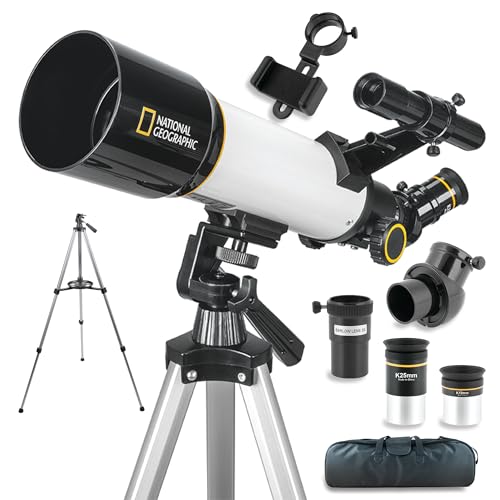 Best for travel and gift-givingNational Geographic Sky View 70mm Refractor Telescope with Panhandle MountView on Amazon
Our Top Picks
Quick Comparison
| Product | Best for | Key feature |
|---|---|---|
| Celestron AstroMaster 70AZ Refractor Telescope | Overall beginner use | Fully coated glass optics on an alt-azimuth mount |
| Celestron PowerSeeker 80EQ Refractor Telescope | Families with curious kids | 80mm aperture with equatorial tracking |
| Celestron StarSense Explorer DX 102AZ | App-guided beginners | Smartphone-guided navigation |
| Telescope for Adults & Kids, 70MM Aperture FMC Optics | Budget-conscious buyers | Phone adapter and tripod included |
| Telescope for Adults High Powered, 90mm Refractor | Larger planetary views | 90mm aperture with 600mm focal length |
| Hemrsey 90mm Aperture 800mm Refractor Telescope | High magnification | 800mm focal length with 240x listed magnification |
| National Geographic Sky View 70mm Refractor Telescope | Travel and gifts | Panhandle mount and two eyepieces |
Celestron AstroMaster 70AZ Refractor Telescope for Moon & Planet Viewing
Celestron AstroMaster 70AZ Refractor Telescope for Moon & Planet Viewing | Fully Coated Glass Optics, Crisp Moon & Planetary Views, Alt-Azimuth Mount with Easy Manual Controls, Beginner Friendly
Best for: Overall beginner use
This is a classic starter refractor for parents who want a simple, dependable scope that handles both the Moon and bright planets. Its manual alt-azimuth mount is easy for a child to point at a target.
Key specs
- 70mm aperture refractor
- Fully coated glass optics
- Alt-azimuth mount with manual controls
Pros
- Simple setup suited to first-time users
- Glass optics generally give crisp planetary contrast
- Lightweight enough for a child to carry outside
Cons
- Manual tracking means targets drift out of view quickly at higher magnification
- Small aperture limits how much detail planets reveal
Bottom line: A strong first choice for families who want a reliable, no-fuss planetary scope.
View on AmazonCelestron PowerSeeker 80EQ Refractor Telescope for Moon & Planet Viewing
Celestron PowerSeeker 80EQ Refractor Telescope for Moon & Planet Viewing | Large 80mm Refractor, Bright Views of the Best Celestial Objects, Smooth Equatorial Tracking, Stable Tripod, Easy to Use
Best for: Families with curious kids
The larger 80mm objective gathers more light than a 70mm scope, which helps planets look brighter. The equatorial mount makes it easier to follow a planet across the sky once it is centered.
Key specs
- 80mm refractor aperture
- Equatorial mount for smooth tracking
- Sturdy tripod
Pros
- Brighter planetary images than 70mm refractors
- Equatorial tracking keeps planets in the eyepiece longer
- Stable tripod reduces wobble when kids touch the tube
Cons
- Equatorial alignment takes some practice for young users
- Heavier to carry than smaller refractors
Bottom line: Good for families willing to spend a few extra minutes learning the mount in exchange for better planet views.
View on AmazonCelestron StarSense Explorer DX 102AZ App-Enabled Refractor Telescope
Celestron StarSense Explorer DX 102AZ App-Enabled Refractor Telescope | Smartphone-Guided Navigation, Premium Refractor Telescope with Manual Mount, Moon & Planet Viewing, Great for Beginners
Best for: App-guided beginners
This model pairs a larger 102mm refractor with a smartphone app that helps you locate objects. For parents unsure where to start, the guided process removes much of the frustration.
Key specs
- 102mm refractor aperture
- Smartphone-guided navigation
- Manual alt-azimuth mount
Pros
- Larger aperture for more planetary detail
- App guidance helps beginners find planets quickly
- Good fit for kids who like technology
Cons
- Relies on a phone and app, which may drain battery
- Larger tube is bulkier to transport
Bottom line: Best for families who want the scope to help them find targets without memorizing star charts.
View on AmazonTelescope for Adults & Kids, 70MM Aperture FMC Optics Telescopes for Astronomy Beginners
Telescope for Adults & Kids, 70MM Aperture FMC Optics Telescopes for Astronomy Beginners, 300MM Refractor Telescope (15X-150X) with Phone Adapter and Tripod, Travel Gifts for Moon, Jupiter and Star
Best for: Budget-conscious buyers
This budget-oriented kit includes a phone adapter and tripod, so you can start photographing or sharing views right away. It suits a first look at the sky before committing to a bigger scope.
Key specs
- 70mm aperture
- Listed magnification range of 15x to 150x
- Includes phone adapter and tripod
Pros
- Complete kit with accessories included
- Phone adapter makes sharing views easy
- Compact size for travel
Cons
- Budget optics may show less planetary contrast than premium glass
- Listed high magnification is hard to use under typical sky conditions
Bottom line: A sensible low-commitment choice for families testing whether astronomy is a long-term interest.
View on AmazonTelescope for Adults High Powered, 90mm Refractor with 600mm Focal Length
Telescope for Adults High Powered, 90mm Refractor with 600mm Focal Length | K10mm/K25mm Eyepieces, 3x Barlow Lens, Phone Adapter, Aluminum Alloy Tripod, Moon And Planet Viewing, Beginner-Friendly Setu
Best for: Larger planetary views
The 90mm aperture and 600mm focal length give a larger, brighter image than the 70mm class. Included eyepieces and a 3x Barlow lens cover a useful range of magnifications.
Key specs
- 90mm refractor aperture
- 600mm focal length
- K10mm and K25mm eyepieces with 3x Barlow lens
Pros
- Bigger aperture than most 70mm kits
- Barlow lens extends magnification options
- Aluminum tripod is light and sturdy enough
Cons
- Brand-specific optical quality is less established than major manufacturers
- Manual mount limits smooth tracking
Bottom line: Good for families who want more light and detail on a moderate budget, with the trade-off of a less established brand.
View on AmazonHemrsey 90mm Aperture 800mm Refractor Telescopes for Adults High Powered
Hemrsey 90mm Aperture 800mm Refractor Telescopes for Adults High Powered | FMC Optics, Moon Viewing, Stargazing, Bird Watching, Daytime Scenery, 240X Magnification, Aluminum Tripod, Easy Setup
Best for: High magnification
The 800mm focal length gives longer-focus views that can enlarge planets when seeing conditions are steady. It also works for daytime landscapes and birdwatching, making it versatile.
Key specs
- 90mm aperture
- 800mm focal length
- Aluminum tripod
Pros
- Long focal length suits higher planetary magnification
- Works for daytime and terrestrial use too
- Easy setup for beginners
Cons
- Listed 240x magnification is rarely usable in practice
- Less established brand with limited owner feedback history
Bottom line: A good option for families who want flexibility beyond night-sky viewing.
View on AmazonNational Geographic Sky View 70mm Refractor Telescope with Panhandle Mount
National Geographic Sky View 70mm Refractor Telescope with Panhandle Mount | 400mm focal length, 2 eyepieces, 3x Barlow lens, smartphone adapter, beginner astronomy for kids and adults
Best for: Travel and gift-giving
This compact refractor with a panhandle mount is easy to pack for camping or a trip to a darker site. It is also a common choice for gifting to young astronomers.
Key specs
- 70mm aperture
- 400mm focal length
- Two eyepieces and a 3x Barlow lens
Pros
- Compact and portable for travel
- Includes eyepieces and a Barlow lens
- Smartphone adapter helps with sharing views
Cons
- Shorter focal length limits high-power planetary detail
- Panhandle mount requires careful handling to stay steady
Bottom line: Ideal for families who need a portable scope for trips or a thoughtful gift.
View on AmazonBuying Guide
Aperture and light-gathering
Aperture, the diameter of the front lens, is the most important number for planetary viewing. A 70mm objective gathers far more light than a 50mm scope, and an 80mm or 90mm objective brightens planets further. More light usually means more visible detail on Jupiter’s bands and Saturn’s rings.
Good picks for this: Celestron PowerSeeker 80EQ Refractor Telescope, Telescope for Adults High Powered, 90mm Refractor
Focal length and magnification
Magnification equals the telescope’s focal length divided by the eyepiece’s focal length. A 600mm scope with a 10mm eyepiece gives 60x. Manufacturers often advertise very high magnification numbers, but planets look best at moderate powers, typically 100x to 150x, depending on sky conditions.
Good picks for this: Hemrsey 90mm Aperture 800mm Refractor Telescopes, Telescope for Adults & Kids, 70MM Aperture FMC Optics
Mount stability
A wobbly mount ruins planetary views. Alt-azimuth mounts are intuitive for beginners, while equatorial mounts track a target smoothly once aligned. Check whether the tripod feels solid when you press the tube lightly.
Good picks for this: Celestron AstroMaster 70AZ Refractor Telescope, Celestron PowerSeeker 80EQ Refractor Telescope
Eyepieces and accessories
Included eyepieces determine your first views. Look for a Barlow lens to increase magnification and a phone adapter if you want to photograph or share what you see. Better eyepieces can improve contrast noticeably on planets.
Good picks for this: National Geographic Sky View 70mm Refractor Telescope, Celestron StarSense Explorer DX 102AZ
Ease of use for kids
A scope a child can set up alone keeps interest high. Lightweight tubes, simple focusing, and app or guided navigation all help. Practice aligning the finder scope in daylight before the first night.
Good picks for this: Celestron StarSense Explorer DX 102AZ, Telescope for Adults & Kids, 70MM Aperture FMC Optics
Portability and storage
Consider how far you will carry the telescope and where it will live. Smaller refractors fit in a closet and travel easily, while larger 90mm and 102mm tubes need more space and a steadier carry.
Good picks for this: National Geographic Sky View 70mm Refractor Telescope, Telescope for Adults High Powered, 90mm Refractor
Care and durability
Keep lens caps on when not in use, store the scope indoors to avoid condensation, and wipe optics with a soft microfiber cloth only. Tighten tripod legs regularly, since vibration loosens them over time.
Good picks for this: Celestron AstroMaster 70AZ Refractor Telescope, Celestron PowerSeeker 80EQ Refractor Telescope
FAQ
What is the best refractor telescope for viewing planets for a beginner?
For most beginners, a 70mm to 90mm refractor on a stable mount offers the best balance of ease and planetary detail. The Celestron AstroMaster 70AZ and Celestron PowerSeeker 80EQ are common starting points.
Is a refractor better than a reflector for planets?
Refractors generally produce high-contrast images with little maintenance, which suits planetary viewing. Reflectors gather more light per dollar of aperture, but they need occasional collimation.
What magnification do I need to see Jupiter’s bands?
Most observers find Jupiter’s cloud bands visible around 100x to 150x in steady conditions. Higher powers rarely add useful detail unless the atmosphere is very calm.
Can kids use a refractor telescope safely?
Yes, but never point any telescope at the Sun without a proper solar filter, because looking at the Sun can cause permanent eye damage. Keep solar viewing for adult supervision with certified filters.
How long does it take to set up a planetary refractor?
Most beginner refractors take about 10 to 20 minutes to assemble and align, especially if you practice in daylight first. Equatorial mounts need a few extra minutes for polar alignment.
Do I need a Barlow lens for planets?
A Barlow lens doubles or triples eyepiece magnification, which can help reveal planetary detail. It is a useful accessory but not required for a good first view.
Conclusion
For a dependable first scope, the Celestron AstroMaster 70AZ is a straightforward choice. Families wanting brighter views and smooth tracking should look at the Celestron PowerSeeker 80EQ. The Celestron StarSense Explorer DX 102AZ suits beginners who want app guidance, while the larger 90mm models and the Hemrsey 800mm refractor appeal to those seeking more detail and flexibility. The National Geographic Sky View is a practical pick for travel and gifts, and the budget 70mm kit works well for testing interest first.
Sources
- Current planetary observing schedules, planet facts and sky-viewing guides for kids and families (nasa.gov)
- Resources for beginner observers, observing clubs and telescope basics from the Astronomical League
- Safety guidance for children and telescope use, including advice on solar viewing hazards (cpsc.gov)
Before you buy: helpful guides
- Best Refractor Telescope for Viewing Planets and Galaxies: A Practical Guide (2026)
- Best Beginner Telescope for Viewing Planets: What to Look For (2026)
- Best Professional Refractor Telescope: 6 Factors and Picks That Matter (2026)
- Which Refractor Telescope for Planets Should Families Buy? Key Factors
- Emerson 50x/100x Refractor Telescope: Is It a Good Fit for Kids?
Related reading
- 3 Best Vivitar Refractor Telescopes with Tripod Picks for Families (2026)
- Which Is Best Reflector or Refractor Telescope? A Family Guide (2026)
About Owen Palmer
Owen Palmer is part of our editorial team and reviews and edits our astronomy for kids, teens & families guides, checking product details against manufacturer specifications and owner feedback.
About the author
Owen Palmer writes reviews and buying guides for Youth in Astronomy.