Christmas Telescope for Kids Activity: 7 Best Picks for Family Stargazing (2026)
Find the best christmas telescope for kids activity with our 7 picks, compared by magnification, aperture, tripod stability and beginner-friendliness. Start sta
 By Caleb Morgan
Updated November 24, 2026
 By Caleb Morgan
Updated November 2026
A christmas telescope for kids activity works best when the telescope is simple enough for a child to set up alone, sturdy enough to survive a few seasons of backyard use, and rewarding enough to keep a young stargazer interested after the wrapping paper is gone. This guide compares seven products on the criteria that matter most to families: aperture (the diameter of the main lens or mirror, which controls how much light reaches the eye), mount type, tripod stability, eyepiece quality, portability and whether the kit includes useful extras like a phone adapter, finder scope or planisphere. We looked at manufacturer specifications, brand track record and the patterns owners commonly report, and we did not test these units ourselves.
Our top picks at a glance
- 1TOP CHOICEBest overallGskyer 70mm Aperture 400mm AZ Mount RefractorView on Amazon
- 2
 TOP CHOICEBest for travelDianfan Telescope for Kids and Adults 80mm 500mm Portable RefractorView on Amazon
- 3
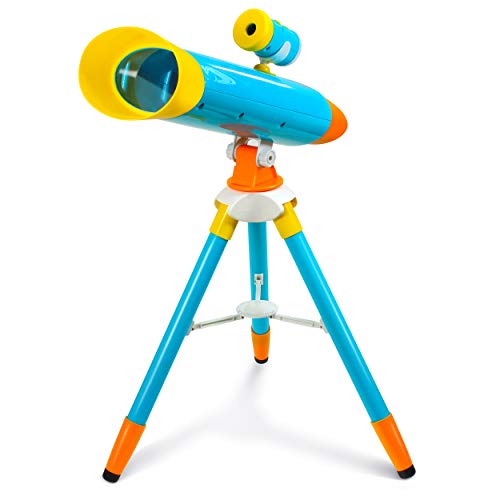 TOP CHOICEBest for younger kidsLittle Experimenter Projector Telescope, 24 Space ImagesView on Amazon
- 4
 Best budget pickTelescope for Kids 50mm 100x Beginner Telescope with TripodView on Amazon
- 5
 Best for moon viewingNASA Lunar Telescope for Kids Ages 8-12 with Tripod and Finder ScopeView on Amazon
- 6
 Best for a complete starter kitTelescope for Kids with Compass and 3 EyepiecesView on Amazon
- 7
 Best for family sharingTelescope for Kids and Adults 70/500 Astronomy Telescope for BeginnersView on Amazon
Our Top Picks
Quick Comparison
| Product | Best for | Key feature |
|---|---|---|
| Gskyer 70mm Aperture 400mm AZ Mount Refractor | Balanced all-around use | 70mm aperture with carry bag and wireless remote |
| Telescope for Kids 50mm 100x with Tripod | Budget-minded families | Two eyepieces and finder scope |
| NASA Lunar Telescope for Kids | Moon and planet viewing | 90x magnification with tabletop tripod |
| Dianfan 80mm 500mm Portable Refractor | Travel and road trips | 80mm aperture with backpack and stickers |
| Little Experimenter Projector Telescope | Ages 3 to 12 and STEM play | Projects 24 space images |
| Telescope for Kids with Compass and 3 Eyepieces | First-time owners wanting extras | Three eyepieces and a compass |
| Telescope for Kids and Adults 70/500 Refractor | Shared family use | Phone adapter and tripod for landscapes |
Gskyer 70mm Aperture 400mm AZ Mount Refractor
Gskyer Telescope, 70mm Aperture 400mm AZ Mount Astronomical Refracting Telescope for Kids Beginners – Travel Telescope with Carry Bag, Phone Adapter and Wireless Remote.
Best for: Balanced all-around use
This is a refractor aimed at families who want one telescope to handle moon viewing, bright planets and daytime landscapes, with enough portability to move between the backyard and a campsite.
Key specs
- 70mm objective lens aperture
- 400mm focal length
- Azimuth (AZ) mount
- Includes carry bag, phone adapter and wireless remote
Pros
- Larger aperture than many starter tubes, which helps brighten the Moon and Saturn’s rings
- The AZ mount is intuitive for children to move by hand
- Carry bag makes storage and transport simple
Cons
- Lightweight tripods can wobble at high magnification
- Owners often find the phone adapter easier to use with patience
Bottom line: A strong first choice for families who want flexibility and a portable setup that grows with the child.
View on AmazonTelescope for Kids 50mm 100x Beginner Telescope with Tripod
Telescope for Kids, 50mm 100x Beginner Telescope with Tripod | 2 Eyepieces, Finder Scope, Hands-On STEM Learning, Space Exploration Fun, Educational Toy Gift for Boys & Girls Ages 6-12
Best for: Best budget pick
A budget-friendly beginner telescope for children roughly ages 6 to 12, with extras that make a first session less intimidating.
Key specs
- 50mm aperture
- Up to 100x magnification as listed
- Includes two eyepieces and a finder scope
Pros
- Two eyepieces let kids compare low and higher power views
- Finder scope helps aim before looking through the main tube
- Simple setup for first-time users
Cons
- A 50mm aperture gathers less light, so faint objects are hard to see
- Very high magnification shows image shake on this type of tripod
Bottom line: Ideal for families who want an affordable introduction and are mainly interested in the Moon and bright planets.
View on AmazonNASA Lunar Telescope for Kids Ages 8-12 with Tripod and Finder Scope
NASA Lunar Telescope for Kids Ages 8-12 with Tripod and Finder Scope | 90x Magnification, Two Eyepieces, Tabletop Tripod, Beginner Astronomy, Space Toys, NASA Birthday Gift
Best for: Best for moon viewing
A tabletop-friendly telescope built around the Moon and a space-themed experience, suited to kids who enjoy the story behind what they see.
Key specs
- Listed magnification of 90x
- Tabletop tripod
- Finder scope and two eyepieces
Pros
- Easy to set on a windowsill or table for quick views
- Themed design appeals to space-loving children
- Finder scope speeds up aiming
Cons
- Tabletop tripods offer limited height for adult viewers
- Not well suited to deep-sky objects
Bottom line: A good pick for families who want quick Moon sessions and a fun, themed gift.
View on AmazonDianfan Telescope for Kids and Adults 80mm 500mm Portable Refractor
Dianfan Telescope for Kids & Adults, 80mm 500mm Portable Refractor, Purple | High Powered Astronomy Travel Telescope for Beginners, Fully Multi-Coated Optics, Tripod, Phone Adapter, Stickers & Backpac
Best for: Best for travel
A portable refractor with a larger aperture than most kids’ starter tubes, designed for families who travel to darker skies.
Key specs
- 80mm aperture
- 500mm focal length
- Includes tripod, phone adapter, stickers and backpack
Pros
- 80mm aperture collects more light than 50mm or 70mm tubes
- Backpack makes transport easy on trips
- Phone adapter supports quick photos of the Moon
Cons
- Larger tube is heavier to carry than compact travel scopes
- Tripod height may require adult help for younger children
Bottom line: Best for families who regularly travel and want more light-gathering power in a backpack-friendly package.
View on AmazonLittle Experimenter Projector Telescope, 24 Space Images
Little Experimenter Projector Telescope, 24 Space Images, STEM Kids 3-12 | STEM Science Toy, Learning Gift for Boys & Girls Ages 3-12
Best for: Ages 3 to 12 and STEM play
This is not a traditional optical telescope. It projects space images, which makes it a good choice for younger children who are not ready for a real eyepiece.
Key specs
- Projects 24 space images
- Designed for ages 3 to 12
Pros
- No aiming or focusing needed, so children can start immediately
- Works well indoors on cloudy nights
- Encourages conversation about planets and stars
Cons
- Does not show the real night sky
- Older children may outgrow it quickly
Bottom line: A good fit for preschool and early-elementary children, or as a companion to a real telescope.
View on AmazonTelescope for Kids with Compass and 3 Eyepieces
Telescope for Kids, Space Toys for Kids Includes Compass & 3 Eyepieces, Great Portable Telescope as Astronomy Gifts, Educational STEM Kit for Boys and Girls to See Moon
Best for: Best for a complete starter kit
A kit-style telescope with several accessories, useful for families who want a single package to get started.
Key specs
- Three eyepieces
- Includes a compass
- Portable design marketed for moon viewing
Pros
- Three eyepieces offer a range of magnifications
- Compass supports simple navigation lessons
- Good for gift-giving with extras included
Cons
- Accessory-heavy kits sometimes have uneven build quality
- Specific aperture details should be checked on the listing
Bottom line: Suited to first-time families who value a complete set of accessories in one box.
View on AmazonTelescope for Kids and Adults 70/500 Astronomy Telescope for Beginners
Telescope for Kids and Adults, 70/500 Astronomy Telescope for Beginners | Kids' Christmas Gift, Refractor Telescope with Phone Adapter and Tripod, Outdoor Stargazing and Landscape Viewing
Best for: Best for family sharing
A refractor sized for both children and adults, with landscape viewing as well as astronomy, which helps it earn regular use beyond the holidays.
Key specs
- 70mm aperture
- 500mm focal length
- Includes phone adapter and tripod
Pros
- Works for daytime landscapes and wildlife as well as the night sky
- Phone adapter supports family photos
- Good balance of aperture and portability
Cons
- Tripod may need tightening after repeated adjustments
- Younger children may need help reaching the eyepiece
Bottom line: A practical choice for parents who want a telescope the whole family can use together.
View on AmazonBuying Guide
Aperture and light-gathering
Aperture, the diameter of the main lens or mirror, matters more than magnification in most cases. A 50mm lens gathers less light than a 70mm or 80mm lens, which affects how bright the Moon, planets and brighter star clusters appear. Manufacturers often advertise high magnification numbers, but magnification without enough aperture produces dim, blurry images.
Good picks for this: Gskyer 70mm Aperture 400mm AZ Mount Refractor, Dianfan 80mm 500mm Portable Refractor
Mount type and ease of use
Altitude-azimuth (AZ) mounts move up-down and left-right, which is the most intuitive motion for children. Equatorial mounts are more precise for tracking objects but are harder to learn. For a first telescope, an AZ mount keeps frustration low.
Good picks for this: Gskyer 70mm Aperture 400mm AZ Mount Refractor, Telescope for Kids and Adults 70/500 Astronomy Telescope for Beginners
Tripod stability
A wobbly tripod ruins views, especially at higher magnification. Check the listed maximum height and whether the legs are metal or plastic. Tabletop tripods work for quick Moon sessions but may force kids to bend awkwardly.
Good picks for this: NASA Lunar Telescope for Kids Ages 8-12 with Tripod and Finder Scope, Telescope for Kids 50mm 100x Beginner Telescope with Tripod
Eyepieces and magnification range
Two or three eyepieces let children switch between wide, low-power views and closer, higher-power views. Low power is easier to aim and find objects with; high power is best for the Moon and planets under steady conditions.
Good picks for this: Telescope for Kids with Compass and 3 Eyepieces, Telescope for Kids 50mm 100x Beginner Telescope with Tripod
Portability and storage
If you travel, weight and packed size matter. A carry bag or backpack keeps lenses protected and makes the telescope easier to bring to a dark-sky site. Larger aperture tubes are heavier, so balance light-gathering with carrying comfort.
Good picks for this: Dianfan 80mm 500mm Portable Refractor, Gskyer 70mm Aperture 400mm AZ Mount Refractor
Age range and child readiness
Younger children often enjoy projection or simple, tabletop telescopes, while children around age 8 and older can handle real eyepiece viewing. Check the manufacturer’s recommended age, but also consider attention span and comfort with setup steps.
Good picks for this: Little Experimenter Projector Telescope, NASA Lunar Telescope for Kids Ages 8-12 with Tripod and Finder Scope
Care and durability
Keep lenses capped when not in use, avoid touching optical surfaces, and store the telescope indoors to prevent condensation. Lenses should be cleaned only with a soft brush or lens cloth. Tighten the tripod and mount hardware periodically, since young users often loosen them.
Good picks for this: Telescope for Kids and Adults 70/500 Astronomy Telescope for Beginners, Telescope for Kids with Compass and 3 Eyepieces
FAQ
What age is a telescope for kids suitable for?
Many beginner telescopes list ages 6 to 12 or 8 and up. Projection toys can start around age 3. Consider reading ability, patience and how comfortable your child is with setup steps, not only the age on the box.
How much magnification does a child really need?
Most beginners get the best results from low-to-medium power. Very high magnification shows less light and more image shake, so listed numbers like 100x or 150x are often less useful than they sound.
Can a kids telescope show planets?
Some can. Jupiter, Saturn and Venus are usually visible as small disks or shapes, and Saturn’s rings can be seen with a larger aperture on a steady mount. Expect modest views rather than detailed photographs.
Is a refractor better than a reflector for children?
Refractors are sealed, need little collimation (mirror alignment) and are usually easier for beginners. Reflectors can gather more light per dollar of aperture but require more adjustment. Most family starter kits are refractors for this reason.
Where should we observe from?
Choose a spot away from street lights, ideally with a clear view of the sky and a flat, stable surface. Let the telescope adjust to outdoor temperature for 15 to 30 minutes before observing to reduce blurry images.
Is it safe to look at the Sun with a kids telescope?
No. Never point any optical telescope at the Sun without a proper full-aperture solar filter designed for that instrument. Most kids’ telescope kits do not include one, and cheap filters or eyepiece filters can crack and cause serious eye injury. Consult a qualified astronomy club or professional if you want to observe the Sun safely.
Do we need a phone adapter?
It is optional. A phone adapter lets you take photos of the Moon or views through the eyepiece, which can be a fun activity for children. Results vary by phone camera and adapter fit.
Conclusion
For most families, the Gskyer 70mm Aperture 400mm AZ Mount Refractor offers the most balanced mix of aperture, mount and portability. Families on a tighter budget may prefer the Telescope for Kids 50mm 100x with Tripod, while travelers will appreciate the Dianfan 80mm 500mm Portable Refractor. Younger children who are not ready for eyepieces may enjoy the Little Experimenter Projector Telescope, and the NASA Lunar Telescope suits quick Moon sessions. Whichever you choose, a christmas telescope for kids activity is most successful when you set it up together, practice aiming in daylight and keep sessions short and fun.
Sources
- Moon phases, planet visibility and general guidance on beginner stargazing (nasa.gov)
- Educational resources on astronomy and space science for young learners
- Astronomical Society of the Pacific guidance for families and new observers
Before you buy: helpful guides
- Tasco Beginner Telescope 45T: Setup, First Views and Tips for Kids
- Emerson 50x/100x Refractor Telescope: Is It a Good Fit for Kids?
- What Is a 600 X 50 Refractor Telescope and Is It Good for Kids?
- Celestron PowerSeeker 60EQ Refractor Telescope: Is It Right for Kids?
- Saxon Novo 607AZ Refractor Kids Telescope: Is It Right for Your Family?
About Caleb Morgan
Caleb Morgan is part of our editorial team and reviews and edits our astronomy for kids, teens & families guides, checking product details against manufacturer specifications and owner feedback.
About the author
Caleb Morgan writes reviews and buying guides for Youth in Astronomy.