5 Best Dobsonian Telescopes with Tracking for Beginners (2026)
Looking for a dobsonian telescope with tracking? We compare five models on tracking, aperture, portability and ease of use to help you choose.
 By youthinastronomy editorial team
Updated November 7, 2026

As an Amazon Associate I earn from qualifying purchases. This page may contain affiliate links.
Shopping for a dobsonian telescope with tracking can be confusing, because the word “dobsonian” usually means a simple, large-aperture reflector on a rocking base, while “tracking” can mean anything from a motor that keeps a planet centered to a full computerized mount that finds objects for you. Families and young astronomers often want a telescope that is easy to carry outside, quick to set up, and able to keep a target in view long enough to enjoy it. The picks below were chosen by comparing manufacturer specifications, brand reputation and common patterns in owner feedback. The criteria were aperture for light-gathering, the type of tracking or guidance offered, portability, setup time, and how well each model suits a beginner or a family using it together.
Our Top Picks
Quick Comparison
| Product | Best for | Key feature |
|---|---|---|
| Celestron StarSense Explorer 114AZ App-Enabled Tabletop Dobsonian Telescope | Kids and first-time observers with a phone | Smartphone app that guides you to objects |
| Sky-Watcher Classic 200 Dobsonian 8-inch Telescope | Families wanting a traditional, sturdy scope | 8-inch solid-tube aperture on a simple base |
| ZWO Seestar S30 Pro Smart Telescope, App-Controlled Astrophotography | Users who want automatic tracking and photos | Auto tracking and GoTo with one-tap capture |
| Sky-Watcher Flextube 250 Dobsonian 10-inch Collapsible Large Aperture Telescope | Observers who want the most light and can carry a larger scope | 10-inch collapsible tube for large aperture |
| Sky-Watcher Flextube 200 Dobsonian 8-inch Collapsible Large Aperture Telescope | Portable backyard observing with an 8-inch aperture | Collapsible tube that packs down for transport |
Celestron StarSense Explorer 114AZ App-Enabled Tabletop Dobsonian Telescope
Celestron StarSense Explorer 114AZ App-Enabled Tabletop Dobsonian Telescope | 114mm Tabletop Dobsonian, Smartphone Dock, App, IPhone, Android Compatible
This model suits children, teens and new stargazers who already own a smartphone and want help finding objects in the sky. It is a compact tabletop design, so it fits on a table or a sturdy stand rather than a full floor mount.
Key specs
- 114mm (about 4.5-inch) aperture reflector
- Tabletop dobsonian mount with a smartphone dock
- Works with the Celestron app on iPhone and Android
Pros
- The app-guided alignment makes finding targets much easier for beginners.
- Compact size is easy to carry out to a backyard or balcony.
- The smartphone dock keeps the phone steady for shared viewing.
Cons
- The aperture is smaller than the 8-inch and 10-inch options, so faint objects look dimmer.
- Relies on a phone for its guidance features, which some owners find limiting.
Sky-Watcher Classic 200 Dobsonian 8-inch Telescope

Sky-Watcher Classic 200 Dobsonian 8-inch Telescope – Solid-Tube – Simple, Traditional Design – Easy to Use, Perfect for Beginners, White (S11610)
This is a good fit for families who want a traditional, no-frills dobsonian that stays simple to use for years. The solid tube is less portable than a collapsible design, but it is straightforward to set up.
Key specs
- 8-inch (200mm) aperture Newtonian reflector
- Solid tube on a dobsonian rocker base
- White finish
Pros
- The 8-inch aperture gathers far more light than a typical small refractor.
- A simple design with few parts to misplace or adjust.
- Strong reputation among beginners for planetary and lunar viewing.
Cons
- The solid tube is bulky to transport and store.
- Manual rocker-base movement means it does not track objects automatically.
ZWO Seestar S30 Pro Smart Telescope, App-Controlled Astrophotography
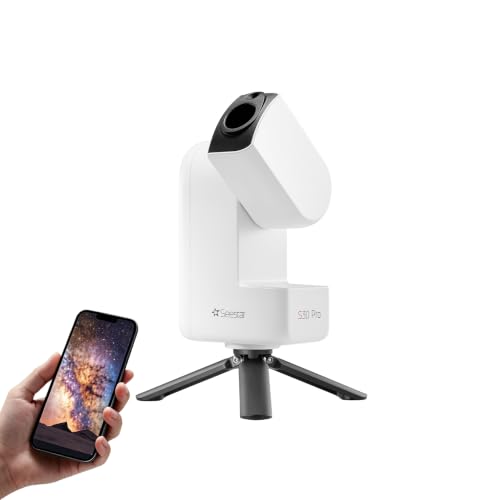
ZWO Seestar S30 Pro Smart Telescope, App-Controlled Astrophotography | 4K Dual Camera, Auto Tracking & GoTo, One-Tap Capture & Processing, Milky Way & Star Trail, Deep Sky & Wide-Field Imaging
This is the choice for users who care most about automatic tracking and imaging. It is closer to a smart, computer-guided instrument than a classic dobsonian, and it suits people who want to take photos of deep-sky objects with a phone-based workflow.
Key specs
- Auto tracking and GoTo control through the app
- Dual camera system with 4K capture
- One-tap capture and processing
Pros
- Automatic tracking keeps targets centered during longer exposures.
- Simple one-tap workflow is approachable for young users.
- Good for Milky Way and star-trail photography without manual setup.
Cons
- Depends on a phone app and a battery or power source, so it is less of a traditional eyepiece experience.
- Owners who prefer visual observing through an eyepiece may find it less satisfying.
Sky-Watcher Flextube 250 Dobsonian 10-inch Collapsible Large Aperture Telescope

Sky-Watcher Flextube 250 Dobsonian 10-inch Collapsible Large Aperture Telescope – Portable, Easy to Use, Perfect for Beginners, White/Black (S11720)
This model is for experienced families or older teens who want the most light-gathering power in a collapsible dobsonian. It rewards careful handling and a stable spot in the yard.
Key specs
- 10-inch (250mm) aperture Newtonian reflector
- Collapsible truss tube for easier transport
- White and black finish
Pros
- The 10-inch aperture shows noticeably more detail on galaxies and star clusters.
- The collapsible design is easier to carry than a solid-tube scope of the same size.
- Strong value for observers who want a large aperture without a computerized mount.
Cons
- Heavier and larger when assembled, so one adult is best for carrying it.
- No automatic tracking, so the view drifts and must be nudged by hand.
Sky-Watcher Flextube 200 Dobsonian 8-inch Collapsible Large Aperture Telescope

Sky-Watcher Flextube 200 Dobsonian 8-inch Collapsible Large Aperture Telescope – Portable, Easy to Use, Perfect for Beginners (S11700)
This is a practical middle choice for families who want the 8-inch light-gathering of a classic dobsonian but need something that packs down for the car. It is well suited to occasional trips to darker sites.
Key specs
- 8-inch (200mm) aperture Newtonian reflector
- Collapsible truss tube design
- Dobsonian rocker base
Pros
- Collapses for easier transport than a solid-tube 8-inch.
- Large aperture for its size, good for planets and bright deep-sky objects.
- Simple to assemble and use without special tools for most owners.
Cons
- No motorized tracking, so objects drift out of view and must be re-centered by hand.
- Still requires a flat, stable spot and some setup time each night.
Buying Guide
Before choosing, decide what “tracking” means for your family. A true dobsonian has no motor, so you keep objects centered by nudging the tube. Some owners add a motorized tracking accessory or choose an app-guided model, which can follow objects for you. Think about how you will use the telescope: visual observing through an eyepiece, photography, or a mix of both.
Selection criteria
- Aperture: Larger mirrors collect more light. Manufacturers typically list aperture in millimeters or inches, and 8 inches (200mm) is a common step up for deep-sky viewing.
- Tracking type: Manual, motorized, or app-guided automatic tracking. Check whether tracking is built in or sold separately.
- Portability: Solid tubes are sturdier but bulkier. Collapsible truss tubes pack more easily.
- Setup time: Count how long assembly and alignment take, especially if children will help.
Important features and specs to check
- Focal length and focal ratio, which affect the field of view and magnification range.
- Included eyepieces and whether the finder scope is easy to align.
- Base stability, since a wobbly rocker makes viewing frustrating.
- Power requirements for any app-controlled or motorized model.
Choosing by need
For young beginners with a phone, an app-guided tabletop model is an easy start. For a traditional family scope, a solid-tube 8-inch is simple and dependable. If you carry the telescope often, a collapsible 8-inch balances light and portability. If photography is the goal, an automatic smart telescope fits better than a manual dobsonian. Those who want the most light and can handle the weight should consider a 10-inch collapsible model.
Things to watch out for
- Dobsonians do not track automatically; a slow-moving planet can leave the eyepiece in a few minutes at high power.
- Large aperture needs a steady spot away from streetlights to show its full potential.
- Manufacturer specifications can differ from what you see in practice, so compare several sources before deciding.
FAQ
What does tracking mean on a dobsonian telescope?
On a standard dobsonian, tracking is manual: you move the tube by hand to keep an object centered as Earth rotates. Some setups add a motor or use an app-guided system that moves the telescope for you.
Is an 8-inch dobsonian good for beginners?
Many beginners find an 8-inch aperture a strong starting point because it shows far more detail on deep-sky objects than a small scope. It does require more setup and carrying effort than a tabletop model.
Can children use a dobsonian telescope?
Yes, though an adult should help with setup and carrying. Smaller tabletop models with app guidance are often easier for younger children to operate on their own.
Do I need a motorized mount for planets?
Not necessarily, but planets move across the eyepiece quickly at higher magnification. A motor or automatic tracking makes long viewing sessions more comfortable.
Is a collapsible dobsonian as stable as a solid-tube model?
Collapsible truss tubes are designed for portability and can perform well, but stability depends on a firm base and careful handling. Solid tubes are generally more rigid.
What is the best place to set up a dobsonian?
Choose a flat, stable surface away from streetlights and house lights. A darker location improves the view of faint objects, and a level spot keeps the rocker base steady.
Should I consult anyone before buying?
If you plan to buy for a school, club, or group, a local astronomy club can offer hands-on advice and let you look through several models before deciding.
Conclusion
A dobsonian telescope with tracking can mean very different things, so match the model to your goals. The Celestron StarSense Explorer suits young or first-time observers who want app guidance. The Sky-Watcher Classic 200 fits families who want a simple, traditional 8-inch. The ZWO Seestar S30 Pro is the pick for automatic tracking and astrophotography. The 10-inch Flextube 250 suits those who want the most light and can handle the weight. The 8-inch Flextube 200 balances aperture and portability for occasional trips. Compare the specs against how you plan to observe, and you will find the right fit.
About the author

youthinastronomy editorial team writes reviews and buying guides for Youth in Astronomy.