6 Best Solar System Planetarium Projectors for Kids (2026)
Compare 6 solar system planetarium projectors for kids, from talking planet models to ceiling star projectors. See who each one suits and what to check before y
 By Emily Parker
Updated November 20, 2026
 By Emily Parker
Updated November 2026
A solar system planetarium projector casts planets, moons and star fields onto a wall or ceiling so kids can explore the night sky without leaving the room. The picks below were chosen by comparing product listings, brand reputation and common owner feedback, with attention to age range, projection features, sound options and whether the unit teaches real astronomy or just decorates a bedroom. For a broader look at this category, see 6 Best Science Can Solar System Planetarium Projectors for Kids (2026).
Our top picks at a glance
- 1TOP CHOICEBest overallScience Can Solar System for Kids, Talking Astronomy Solar System Model KitView on Amazon
- 2
 TOP CHOICEBest for toddlers and early readersGalaxy Projector Pro for Bedroom, 13 Space Discs Planetarium ProjectorView on Amazon
- 3
 TOP CHOICEBest for bedtime routinesGalaxy Projector Night Light, 13-in-1 Star Projector for BedroomView on Amazon
- 4
 Best for variety of scenesFlyLily Galaxy Projector, 12 in 1 HD Planetarium Astronaut Galaxy ProjectorView on Amazon
- 5
 Best for sleep-focused rooms[White Noise] Galaxy Projector, 28 Soothing Sounds Star Projector Sound MachineView on Amazon
- 6
 Best for hands-on scienceSmithsonian Optics Room Planetarium and Dual Projector Science KitView on Amazon
Our Top Picks
Quick Comparison
| Product | Best for | Key feature |
|---|---|---|
| Science Can Solar System for Kids | Overall learning | Talking planet model |
| Galaxy Projector Pro for Bedroom | Toddlers and early readers | 13 space discs |
| Galaxy Projector Night Light | Bedtime routines | 13 scenes, 360° rotation |
| FlyLily Galaxy Projector | Variety of scenes | 12 scenes, HD projection |
| White Noise Galaxy Projector | Sleep-focused rooms | 28 built-in sounds |
| Smithsonian Optics Room Planetarium | Hands-on science | Dual projector, age 8+ |
Science Can Solar System for Kids, Talking Astronomy Solar System Model Kit
Science Can Solar System for Kids, Talking Astronomy Solar System Model Kit | Planetarium Projector w/ 8 Planets, Bilingual EN/ES, STEM Educational Toys, Space Toys Gift for 3 4 5 6 7 Year Old Boys Gi
Best for: Overall learning
This suits younger children who are starting to name the planets and want a model that talks back as they explore.
Pros
- Projects eight planets with spoken facts
- Bilingual English and Spanish narration
Cons
- Best suited to younger ages than older kids may want
Galaxy Projector Pro for Bedroom, 13 Space Discs Planetarium Projector
Galaxy Projector Pro for Bedroom, 13 Space Discs Planetarium Projector | Star Ceiling Projector Night Light, STEM Educational Astronomy Toy Space Learning Gift for Kids Boys Girls Room Decor – White
Best for: Toddlers and early readers
A good fit for kids who want a simple, calming display with a range of space images to point at and name.
Pros
- Includes 13 interchangeable space discs
- Simple controls suited to young children
Cons
- Projection is more decorative than instructional
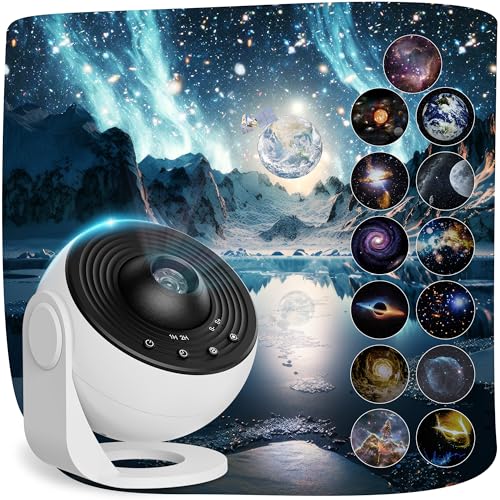
Galaxy Projector Night Light, 13-in-1 Star Projector for Bedroom
Galaxy Projector Night Light, 13-in-1 Star Projector for Bedroom, White | Planetarium Projector and Night Light Projector with 13 Space Scenes, Ceiling Projection, 360° Rotation, Focus and Timer
Best for: Bedtime routines
This works well for families who want a soft glow at night with a timer that switches the projector off on schedule.
Pros
- Timer and 360° rotation for gentle motion
- Thirteen scenes to choose from
Cons
- Fine focus adjustment takes some patience
FlyLily Galaxy Projector, 12 in 1 HD Planetarium Astronaut Galaxy Projector
FlyLily Galaxy Projector, 12 in 1 HD Planetarium Astronaut Galaxy Projector for Bedroom, Galaxy Star Night Light Projector for Kids Adults Gaming Room/Party/Home Décor
Best for: Variety of scenes
Suited to families who want frequent scene changes and a projector that also works in a playroom or game space.
Pros
- Twelve scene options in one unit
- HD-labeled projection for sharper images
Cons
- Scene content leans more toward decor than detailed astronomy
[White Noise] Galaxy Projector, 28 Soothing Sounds Star Projector Sound Machine
[White Noise] Galaxy Projector, 28 Soothing Sounds Star Projector Sound Machine, Solar System Space Planetarium Projector Night Light, Room Decor for Ceiling Bedroom Adults Sleep Aid
Best for: Sleep-focused rooms
A practical choice for light sleepers, since the sound machine and projection work together during the same wind-down period.
Pros
- 28 soothing sounds built in
- Solar system scenes paired with a sleep timer
Cons
- Less focused on teaching the planets in order
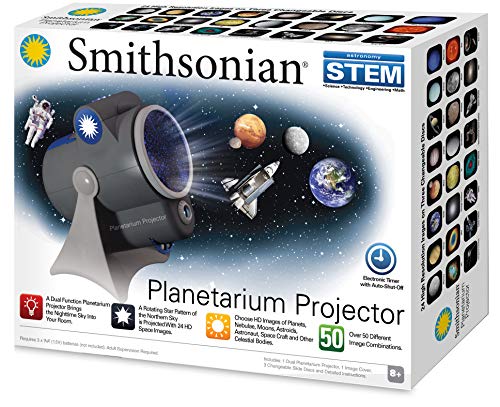
Smithsonian Optics Room Planetarium and Dual Projector Science Kit
Smithsonian Optics Room Planetarium and Dual Projector Science Kit, Black/Blue, Age 8 and Up
Best for: Hands-on science
This is aimed at older kids who want to build and use a projector as a learning tool, often with a parent or teacher nearby.
Pros
- Dual projector setup for more detailed star fields
- Designed as a science kit with an age 8 and up rating
Cons
- Requires more setup time than the simple night lights
Buying Guide
Check the age range and learning goal
Some projectors are built for toddlers who enjoy bright colors, while others assume a reader who wants planet names and facts. Match the unit to your child’s age so the display holds their attention.
Look at the projection type
Single-disc projectors show one scene at a time, while dual or multi-disc models give more variety. Ceiling projection with 360° rotation is common for bedrooms, but check whether you want a fixed image or moving stars.
FAQ
What age is a solar system planetarium projector best for?
Most projectors are designed for children around 3 to 8 years old, though the best fit depends on the model. Simpler galaxy and night light projectors suit younger kids, while the Smithsonian kit is aimed at ages 8 and up and includes more hands-on science.
Do these projectors actually teach astronomy?
Some do more than others. Models with planet labels, talking features or a dedicated science kit can introduce real solar system concepts, while decorative galaxy projectors mainly create a calming star-filled atmosphere.
What is the difference between a planetarium projector and a galaxy projector?
A planetarium projector usually focuses on showing planets and the solar system in an educational way. A galaxy projector typically casts a broad field of stars, nebulae and colorful scenes that work well for mood lighting and bedtime.
Can these projectors be used as night lights?
Yes, many of the options double as night lights and offer timers, brightness settings or rotation so you can adjust the glow. Check whether the model has a timer or auto shut-off if you plan to leave it on overnight.
Are white noise or sound features worth considering?
They can be helpful for kids or adults who struggle to fall asleep, since soothing sounds pair well with the projected light. If you only want an educational tool, a model without sound features may be a simpler choice.
Do I need a dark room for the projection to look good?
A darker room makes the images clearer and more vivid, so dimming the lights or closing curtains will help. Projection on a plain ceiling or wall generally works best, and the surface you choose affects how sharp the images appear.
Conclusion
If your child is curious about the planets and you want a learning tool, the Science Can Solar System for Kids or the Smithsonian Optics kit are strong choices, with the Smithsonian suited to older children. For a cozy bedroom glow with a bit of learning mixed in, a galaxy projector with several scene options and a timer will fit most families well.
Families looking for sleep support should consider the white noise model, while those who simply want a dreamy ceiling display can choose any of the galaxy night light projectors based on the number of scenes and features they prefer.
Related reading
- Kidz Labs Solar System Planetarium Model: What It Teaches and How to Use It
- Zeiss Planetarium Projector Price: What to Expect and How to Choose (2026)
- World's First Planetarium Projector: A Practical Guide (2026)
- World First Planetarium Projector (2026): Which Should You Choose?
About Emily Parker
Emily Parker is part of our editorial team and reviews and edits our astronomy for kids, teens & families guides, checking product details against manufacturer specifications and owner feedback.
About the author
Emily Parker writes reviews and buying guides for Youth in Astronomy.