5 Best Solar System Kits for Kids of 2026
Compare 5 solar system kits for kids, from glow-in-the-dark planet models to foam ball sets and talking projectors. Find the right build for your child's age.
 By Emily Parker
Updated November 24, 2026
 By Emily Parker
Updated November 2026
Solar system kits for kids turn a lesson about planets into something a child can hold, paint, and rotate with their own hands. The right kit depends on age, patience, and what you want the project to teach, whether that is the order of the planets, relative sizes, or how the planets move around the Sun. This list focuses on five kits from the same product category, chosen by comparing listing specifications, brand reputation, and the feedback patterns owners tend to mention. We weighed age range, how much assembly is involved, how many planets are included, whether the kit needs adult help, and how well the finished piece holds up as a bedroom display or a school project.
Our top picks at a glance
- 1TOP CHOICEBest overallBuild and Paint 3D Planets with Movable Arms, Space Bedroom Decor, AstView on Amazon
- 2
 TOP CHOICEBest for younger kidswookidel 64 PCS Solar System Project Kit, Solar System for Kids | SolaView on Amazon
- 3
 TOP CHOICEBest for gear-minded buildersSmartivity DIY Solar System Kit – Gear-Driven Planet Model for Kids 8-View on Amazon
- 4
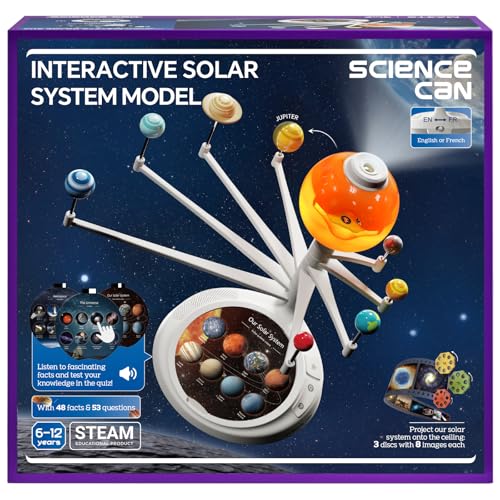 Best for tech-curious familiesScience Can Solar System for Kids, Interactive Talking Solar System MoView on Amazon
- 5
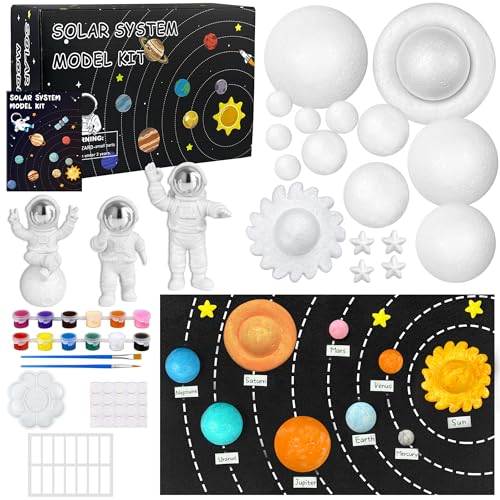 Best budget pick for art projects35PCS Solar System Model Kit Foam Ball Kit Includes Color Pigments PalView on Amazon
Our Top Picks
| Product | Best for | Key feature |
|---|---|---|
| National Geographic Glow in the Dark Solar System Model | Ages 8–12 who want a bedroom display | Glow-in-the-dark 3D planets with movable arms |
| wookidel 64 PCS Solar System Project Kit | Younger children and school projects | 64 pieces with 13 mixed foam balls |
| Smartivity DIY Solar System Kit | Kids ages 8–14 who like mechanical builds | Gear-driven planets that rotate |
| Science Can Solar System for Kids | Families who want an interactive learning tool | HD projector with 8 planets and quiz mode |
| 35PCS Solar System Model Kit Foam Ball Kit | Kids who enjoy painting and decorating | Color pigments, brushes, and a felt background plate |
National Geographic Glow in the Dark Solar System Model for Kids Ages 8-12 | Build and Paint 3D Planets with Movable Arms
Build and Paint 3D Planets with Movable Arms, Space Bedroom Decor, Astronomy STEM Project, Birthday Gift National Geographic Glow in the Dark Solar System Model for Kids Ages 8-12
Best for: Ages 8–12 who want a bedroom display that looks good after the lights go out.
This is a build-and-paint kit aimed at children who enjoy hands-on crafts and want to finish with a piece they can keep. The glow-in-the-dark finish makes it a natural fit for a bedroom or a child’s room where the planets can be seen at night.
Key specs
- Designed for ages 8–12, according to the listing
- 3D planet pieces that are built and painted by the child
- Movable arms for positioning the planets
- Glow-in-the-dark finish
Pros
- Combines painting, assembly, and display in one project
- Glow-in-the-dark finish makes the finished model useful as a night light and a teaching tool
- Movable arms make it easier to show planetary order
Cons
- Painting takes patience, and younger children may need help to keep the lines clean
- Glow effect is strongest after a period of light exposure
Bottom line: A strong choice for a child in the 8–12 range who wants a decorative project that doubles as a night-sky display.
View on Amazonwookidel 64 PCS Solar System Project Kit, Solar System for Kids | Solar System Model Kit with 13 Mix Foam Balls
wookidel 64 PCS Solar System Project Kit, Solar System for Kids | Solar System Model Kit with 13 Mix Foam Balls, Solar System Toys for Kids 3-5, Learn Planets Science School Project Supplies
Best for: Younger children and school projects that need a lot of pieces.
This kit is built around foam balls and a large piece count, which suits children who are still learning to handle small parts. Its age range listed in the title points toward preschool and early elementary students, and the mix of foam balls gives a simple way to show relative planet sizes.
Key specs
- 64 pieces, as stated in the listing name
- 13 mixed foam balls
- Listed for ages 3–5 in the title, with school project supplies included
Pros
- Large piece count gives plenty of material for a full model
- Foam balls are easier for young children to handle than small molded parts
- Works well as a classroom or homework supply
Cons
- Foam balls can be crushed or dented if handled roughly
- Older children may find the build too simple for a detailed science project
Bottom line: A practical pick for younger kids and families who want a full set of pieces for a school-style model.
View on AmazonSmartivity DIY Solar System Kit – Gear-Driven Planet Model for Kids 8-14 | Build, Rotate & Explore the Planets
Smartivity DIY Solar System Kit – Gear-Driven Planet Model for Kids 8-14 | Build, Rotate & Explore the Planets, Christmas & Birthday Gift for Boys & Girls 8, 9, 10, 11, 12, 13 & 14 Years Old
Best for: Kids ages 8–14 who like mechanical builds and want a model that moves.
Smartivity is a known name in building-and-learning toys, and this kit leans into gear-driven mechanics. A child who enjoys understanding how things turn will get more from this than from a static model.
Key specs
- Designed for ages 8–14, according to the listing
- Gear-driven planet model that rotates
- Builds and explores the planets as one project
Pros
- Gears let the child see how planetary motion works in a simple way
- Good match for children who like mechanical toys
- Covers both construction and exploration
Cons
- Gear assembly can be fiddly for the youngest listed age
- The rotating mechanism is less of a display piece than a painted model
Bottom line: Best for older kids who want the planets to move and who enjoy the mechanics as much as the astronomy.
View on AmazonScience Can Solar System for Kids, Interactive Talking Solar System Model | HD Space Projector w/ 8 Planets
Science Can Solar System for Kids, Interactive Talking Solar System Model | HD Space Projector w/ 8 Planets, Bilingual EN/FR, Knowledge & Quiz Mode, STEM Space Toys Gifts for 6 7 8 9 10 Years Old Boys
Best for: Tech-curious families who want an interactive learning tool rather than a craft build.
This is a different kind of kit. Instead of building a model by hand, the child uses a projector and interactive features to explore the planets. It suits families who want quiz-style learning and a bilingual option.
Key specs
- HD space projector with 8 planets, as stated in the listing name
- Talking model with bilingual English and French mode
- Knowledge and quiz modes
- Listed for ages 6–10 in the title
Pros
- Quiz mode turns the model into a repeatable learning activity
- Projector lets the whole family see the planets without building anything
- Bilingual option is useful in multilingual homes
Cons
- Depends on power and electronics, so it is less of a hands-on craft
- Works best in a dim room, which limits daytime use
Bottom line: A good fit for families who want a learning device with quizzes and projection, especially for children ages 6–10.
View on Amazon35PCS Solar System Model Kit Foam Ball Kit with Color Pigments, Palette, Brushes and Felt Background Plate
35PCS Solar System Model Kit Foam Ball Kit Includes Color Pigments Palette Spheres Balls Brushes Felt Background Plate Instruction Manual Astronaut Ornament and More
Best for: Kids who enjoy painting and decorating, and who want a finished display with a background.
This kit focuses on art. It includes color pigments, a palette, brushes, and a felt background plate, so a child can paint the planets and mount them on a backdrop. It is a good match for an art-minded child or a family project that doubles as a craft session.
Key specs
- 35 pieces, as stated in the listing name
- Foam balls for the planets
- Color pigments, palette, and brushes included
- Felt background plate and instruction manual included
Pros
- Includes everything needed to paint the planets
- Felt background plate gives the finished model a finished look
- Instruction manual helps with the order of steps
Cons
- Paint and pigments need a covered work surface and supervision for younger children
- Foam balls are less durable than molded planet pieces
Bottom line: The most art-focused kit on this list, suited to children who would rather paint than assemble.
View on AmazonBuying Guide
Age range and skill level
Check the listed age range first, but also think about the child’s patience. A kit for ages 8–14 may still be too fiddly for a younger child who has never finished a craft. Look for kits that match the child’s fine motor skills, and plan to help with painting or small gears when needed.
Good picks for this: wookidel 64 PCS Solar System Project Kit, Smartivity DIY Solar System Kit
Build type: paint, assemble, or project
Solar system kits fall into a few types. Some are painting kits, some are assembly kits with gears or moving parts, and some are interactive devices. Decide which type your child will enjoy most, because a kit that matches their interest is more likely to get finished.
Good picks for this: National Geographic Glow in the Dark Solar System Model, Science Can Solar System for Kids
Number of planets and included pieces
Count the planets and pieces listed. A complete set helps children learn the order of the planets, while a smaller set may leave gaps. Piece counts stated in listing names, such as 35 or 64, give a quick way to compare the amount of material included. Worth reading next: 6 Best Solar System Planetarium Projectors for Kids (2026).
Good picks for this: wookidel 64 PCS Solar System Project Kit, 35PCS Solar System Model Kit Foam Ball Kit
Durability of the finished model
Foam balls are light and easy to handle, but they dent and crush more easily than molded plastic or painted 3D pieces. If the model will be a long-term display in a child’s room, favor kits with sturdier planet pieces. If it is a short-term school project, foam is usually fine.
Good picks for this: National Geographic Glow in the Dark Solar System Model, Smartivity DIY Solar System Kit
Supervision and safety with paint
Paint, pigments, and brushes are part of many solar system kits. Plan a covered work surface, wash hands after painting, and supervise younger children. If a child has sensitivities to art materials, read the included materials list before buying. For any health concern about art supplies, consult a pediatrician or a qualified professional.
Good picks for this: 35PCS Solar System Model Kit Foam Ball Kit, National Geographic Glow in the Dark Solar System Model
Use case: classroom, home, or gift
A kit for a school project should cover the required planets and fit a deadline, while a home kit can be more detailed and take longer. A gift kit should match the child’s age and interests. Think about where the finished model will go, because that affects size and finish.
Good picks for this: wookidel 64 PCS Solar System Project Kit, Science Can Solar System for Kids
Learning goal: facts, motion, or scale
Some kits teach planet order and names, others show how planets move, and others focus on relative size. If your child is studying motion or orbits, a kit with moving parts will help more than a static display. For a basic introduction to the planets, a simpler model may be enough.
Good picks for this: Smartivity DIY Solar System Kit, Science Can Solar System for Kids
FAQ
What age are solar system kits for kids best for?
Age ranges vary widely. Some kits list ages 3–5, others 6–10, and others 8–14. Check the listed range and the complexity of the build. A child who can follow written steps and handle small parts will usually enjoy a more detailed kit.
Do I need to help my child with a solar system kit?
Younger children usually need help with painting, small gears, or following instructions. Older children may work mostly on their own. Plan to check in during the build, especially if paint or small parts are involved.
Are foam ball solar system kits durable?
Foam balls are lightweight and safe to handle, but they dent and crush more easily than molded or painted hard pieces. They work well for school projects and short-term displays. For a long-term model, consider a kit with sturdier planets.
Can a solar system kit help with a school project?
Yes. Many kits include enough planets and supplies to make a basic model for a school assignment. Check the number of planets and whether the kit includes a background or instruction manual, since teachers often ask for both.
Is a projector-style solar system kit a real learning tool?
It can be. Projector kits with quiz modes encourage repeated questions and answers, which helps children remember planet names and order. They do not replace hands-on building, so many families use both types.
Do glow-in-the-dark kits really glow?
Glow-in-the-dark finishes usually need light exposure to charge before they glow in a dark room. How bright and how long the glow lasts depends on the material, so set expectations for a soft glow rather than a bright light.
What should I check before buying a solar system kit?
Check the age range, the number of planets and pieces, whether paint is included, and whether the finished model suits your space. Read the materials list if your child has sensitivities. For any health question about art materials, consult a pediatrician.
Conclusion
Each of these five kits suits a different kind of young astronomer. The National Geographic model is a strong overall choice for children ages 8–12 who want a painted, glowing display. The wookidel kit gives younger children and school projects a large set of pieces. The Smartivity kit fits older kids who enjoy gears and motion. The Science Can projector is the pick for families who want an interactive quiz-style tool. The 35PCS foam ball kit is best for children who love painting and want a finished backdrop. Match the kit to the child’s age, skill, and interest, and the build is more likely to become a lasting part of their interest in space.
Sources
- Current facts about the planets, their order, and relative sizes for accurate labels in a model (nasa.gov)
- Museum-based resources on the solar system and hands-on astronomy activities for children (si.edu)
- Product safety guidance for toys and craft kits intended for children (cpsc.gov)
Before you buy: helpful guides
Related reading
- Top 5 Model Project of Solar System Kits for Kids in 2026
- Top 5 4M Solar System Model Making Kits for Kids (2026)
- Build a Model Solar System Orrery: 4 Best Kits for Kids (2026)
About Emily Parker
Emily Parker is part of our editorial team and reviews and edits our astronomy for kids, teens & families guides, checking product details against manufacturer specifications and owner feedback.
About the author
Emily Parker writes reviews and buying guides for Youth in Astronomy.