4 Best Dobsonian Telescope Laser Collimators for Easy Alignment
Compare 4 dobsonian telescope laser collimators for easy alignment. See key features, pros, cons and who each one suits before you buy.
 By Owen Palmer
Updated November 26, 2026
 By Owen Palmer
Updated November 2026
A dobsonian telescope laser collimator helps you line up the mirrors in a Newtonian reflector so stars come to a sharp point instead of a smeared blur. Most people who own a dobsonian eventually need to collimate, especially after moving the scope or bumping the tube. The four tools below were selected by comparing published specifications, brand reputation and the patterns owners tend to describe in their feedback, with attention to how each one fits a 1.25-inch focuser, how bright the beam is, and how easy it is to adjust in a dark backyard.
Our top picks at a glance
- 1TOP CHOICEBest overallSVBONY Laser Collimator, for Newtonian Marca Telescope Alignment, 1.25/2" with 2" AdapterView on Amazon
- 2
 Best for beginners on a budgetAstromania Laser Collimator 1.25" for Newtonian Marca Telescope AlignmentView on Amazon
- 3
 Best for lightweight storageAlstar Laser Collimator Alignment for Marca Newtonian Telescopes 1.25 InchView on Amazon
- 4
 Best for a dot-style beamHoTech 1.25" SCA Laser Collimator for Newtonian Telescope – Dot Model SCA-1.25DView on Amazon
Our Top Picks
| Product | Best for | Key feature |
|---|---|---|
| SVBONY Laser Collimator | Most Newtonian owners | Seven brightness levels and a 2-inch adapter option |
| Astromania Laser Collimator 1.25″ | Budget-minded beginners | 45-degree adjusting disk for fine alignment |
| Alstar Laser Collimator Alignment | Frequent transport | Aluminum housing with a light body |
| HoTech 1.25″ SCA Laser Collimator | Users who prefer a dot pattern | Dot-model beam for centering the secondary |
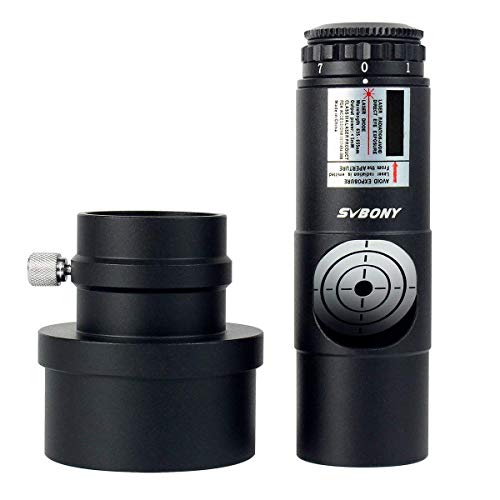
SVBONY Laser Collimator, for Newtonian Marca Telescope Alignment, 1.25/2″ with 2″ Adapter
SVBONY Laser Collimator, for Newtonian Marca Telescope Alignment, 1.25/2" | with 2" Adapter, 7 Bright Levels, Red Laser Collimator for Telescope, Triple Cemented Lens, Laser Alignment Tool
Best for: Owners who want one collimator that works with several focuser sizes and offers adjustable beam brightness.
This tool suits people who own a Newtonian with a 1.25-inch focuser and may later upgrade to a 2-inch setup. The included adapter lets you use it in both sizes without buying a second tool.
Key specs:
- Fits 1.25-inch and 2-inch focusers with the included adapter
- Seven brightness levels for red laser output
- Triple cemented lens listed in the product name
Pros:
- Adjustable brightness helps in both dim and bright conditions
- The 2-inch adapter adds flexibility as your setup grows
- The triple cemented lens is designed to reduce beam distortion
Cons:
- The adapter adds a few small parts to keep track of
- The beam can look bright enough to be distracting at the highest setting
Bottom line: A strong first choice for most dobsonian owners who want flexibility without paying for extras they won’t use.
View on AmazonAstromania Laser Collimator 1.25″ for Newtonian Marca Telescope Alignment
Astromania Laser Collimator 1.25" for Newtonian Marca Telescope Alignment | Red Laser Collimator for Telescope, Telescope Laser Alignment Tool 1.25 Inch, 7 Red Bright Levels, 45 Degree Adjusting Disk
Best for: Beginners who want a simple, low-cost tool with a clear adjusting disk.
This model suits anyone learning collimation for the first time. The 45-degree adjusting disk gives you a visible reference for where to turn the screws, which helps when you are still building intuition.
Key specs:
- 1.25-inch barrel size
- Seven red brightness levels
- 45-degree adjusting disk
Pros:
- Straightforward design that is easy to learn
- The adjusting disk helps you track alignment steps
- Compact enough to keep in a telescope case
Cons:
- Only supports the 1.25-inch size listed
- Fine adjustments can take some patience to dial in
Bottom line: A sensible pick for beginners who want a no-frills tool and plan to stay with a 1.25-inch focuser.
View on AmazonAlstar Laser Collimator Alignment for Marca Newtonian Telescopes 1.25 Inch
Alstar Laser Collimator Alignment for Marca Newtonian Telescopes 1.25 Inch | Red Laser Collimator for Telescope, 7 Bright Levels, Aluminium Housing, 45° Adjusting Disk, Laser Alignment Tool, Lightweig
Best for: Observers who carry their scope to dark sites and want a lighter tool that holds up to travel.
This collimator is aimed at people who move their dobsonian often. The aluminum housing offers durability while keeping weight low enough to toss in a bag with eyepieces and star charts.
Key specs:
- 1.25-inch size
- Seven bright levels
- Aluminum housing
- 45-degree adjusting disk
Pros:
- Aluminum body is sturdier than many plastic alternatives
- Light enough for regular transport
- Adjusting disk aids repeatable alignment
Cons:
- Limited to 1.25-inch focusers
- Owners sometimes report needing to re-check beam centering after bumping the case
Bottom line: Best for observers who travel with their scope and want a rugged, portable collimator.
View on AmazonHoTech 1.25″ SCA Laser Collimator for Newtonian Telescope – Dot Model SCA-1.25D
HoTech 1.25" SCA Laser Collimator for Newtonian Telescope – Dot Model # SCA-1.25D
Best for: Users who prefer a dot-pattern beam when centering the secondary mirror.
This dot-model collimator suits owners who find a dot easier to read than a line or a standard spot. It is a good fit for people who already own a 1.25-inch Newtonian and want a focused, traditional-style laser tool.
Key specs:
- 1.25-inch barrel
- Dot-model beam (per model name SCA-1.25D)
Pros:
- Dot beam makes centering easier to judge by eye
- Simple design with few parts
- Model naming makes it clear which configuration you are buying
Cons:
- Fewer brightness options than some competing models
- Limited to 1.25-inch focusers
Bottom line: Good for observers who specifically want a dot beam and a no-nonsense tool for a standard 1.25-inch setup.
View on AmazonIf you are new to collimation, pairing any of these tools with a clear set of steps will help a lot. Our walkthrough on How to Collimate a Dobsonian Telescope with Laser: A Step-by-Step Guide covers the full process from start to finish, and it works with all four collimators above.
Buying Guide
Focuser Size
Check whether your focuser is 1.25 inches or 2 inches before buying. A collimator must fit the barrel that goes into the focuser, so mismatched sizes waste time and money. Many dobsonians use a 1.25-inch focuser, but some larger models use 2-inch. If your scope accepts both, a tool with an adapter gives you more options.
Good picks for this: SVBONY Laser Collimator, Alstar Laser Collimator Alignment
Beam Brightness Control
Look for a tool with adjustable brightness. Bright beams are easier to see in daylight or with a lit room, while lower settings reduce glare when you are working in the dark. Manufacturers often list several brightness levels, and having more than one lets you match conditions.
Good picks for this: SVBONY Laser Collimator, Astromania Laser Collimator 1.25″
Beam Pattern
Some collimators project a single dot, others a ring or line. Dot patterns are commonly preferred for centering the secondary mirror because the target is easy to read. Choose the pattern you find easiest to interpret, since that matters more than any spec on paper.
Good picks for this: HoTech 1.25″ SCA Laser Collimator, Astromania Laser Collimator 1.25″
Adjusting Disk and Alignment Aids
A 45-degree adjusting disk gives you a reference point for turning the collimation screws. This feature is especially useful for beginners who are still learning which direction each screw moves the beam. Aids like this reduce guesswork during setup.
Good picks for this: Astromania Laser Collimator 1.25″, Alstar Laser Collimator Alignment
Housing Material and Durability
Telescope accessories travel in cases, get dropped, and sit in damp night air. Metal housings, such as aluminum, generally hold up better to knocks than thin plastic. Check the listed materials and consider how often you plan to carry the tool outdoors.
Good picks for this: Alstar Laser Collimator Alignment, SVBONY Laser Collimator
Weight and Portability
If you observe at dark sites that require a drive, weight matters. A light collimator is easier to pack with your eyepieces, finder and star maps. Lightweight tools also reduce the chance of pulling a focuser out of position when you handle the scope.
Good picks for this: Alstar Laser Collimator Alignment, Astromania Laser Collimator 1.25″
Care and Storage
Keep the laser in its case when not in use, and avoid leaving it in direct sun or humid conditions for long periods. Replace batteries when the beam dims, since a weak beam is harder to center accurately. Basic care helps the tool stay aligned with your focuser over many seasons.
Good picks for this: SVBONY Laser Collimator, HoTech 1.25″ SCA Laser Collimator
FAQ
What does a dobsonian telescope laser collimator do?
It projects a laser beam down the focuser so you can see whether the primary and secondary mirrors are aligned. Adjusting the screws until the beam returns to the center of the mirror helps produce sharper images.
Do I need a laser collimator if I have a Cheshire eyepiece?
Not necessarily. A Cheshire eyepiece is another common method. Many observers prefer a laser because the beam is easy to read in a dark setting, but both tools can achieve good results with practice.
How often should I collimate my dobsonian?
Check collimation whenever you move the telescope, change eyepieces in a way that shifts the focuser, or notice stars looking soft. Many owners check it at the start of each observing session.
Can I use a 1.25-inch collimator in a 2-inch focuser?
Only with an adapter. The SVBONY model includes a 2-inch adapter, which lets you use it in a 2-inch focuser. The other models listed here are sized for 1.25-inch focusers.
Why does the laser beam look off-center even after adjusting?
The laser itself may not be centered in its barrel, or the mirror may need small adjustments in multiple steps. Make one small change at a time, and recheck after each adjustment.
Is a dot beam better than a line beam?
Neither is universally better. Dot beams are often preferred for centering the secondary mirror because the target is easy to see. Pick the one you find easiest to read.
Conclusion
For most dobsonian owners, the SVBONY Laser Collimator offers the most flexibility with its adapter and adjustable brightness. The Astromania model is a sensible choice for beginners who want a simple tool with a helpful adjusting disk. The Alstar collimator suits people who travel with their telescope and want a sturdy, lightweight body. The HoTech dot-model collimator is a good fit for observers who prefer a dot pattern and a straightforward setup with a 1.25-inch focuser. Match the tool to your focuser size and how you plan to use it, and you will be well positioned for sharp views.
Sources
- Background on telescope optics and how reflecting telescopes work (nasa.gov)
- Guidance on amateur telescope use and observing practices
- Information on astronomy education and amateur observing resources
Before you buy: helpful guides
Related reading
- Collimating a Dobsonian Telescope: 6 Best Picks Compared for Beginners
- 7 Best Table Top Dobsonian Telescope Picks for Beginners (2026)
- 5 Best Dobsonian Telescope Motorized Mounts Compared (2026)
- 5 Best Dobsonian Telescope GoTo Mount Options for Beginners (2026)
About Owen Palmer
Owen Palmer is part of our editorial team and reviews and edits our astronomy for kids, teens & families guides, checking product details against manufacturer specifications and owner feedback.
About the author
Owen Palmer writes reviews and buying guides for Youth in Astronomy.