3 Best Beginner Deep Space Telescope Picks for 2026
Find the best beginner deep space telescope for your skills and budget. We compare three picks by aperture, mount, and ease of use to help you choose.
 By Caleb Morgan
Updated November 21, 2026
 By Caleb Morgan
Updated November 2026
Choosing a beginner deep space telescope can feel confusing, because the catalog is full of large numbers, bold claims, and gear that looks more complicated than it needs to be. Most new observers want to see galaxies, star clusters, and nebulae without spending weeks learning setup. The picks below were chosen by comparing published specifications, brand reputation, and the patterns owners commonly describe in their feedback. We looked at aperture, mount stability, ease of setup, and whether each model suits a young or first-time observer.
Our top picks at a glance
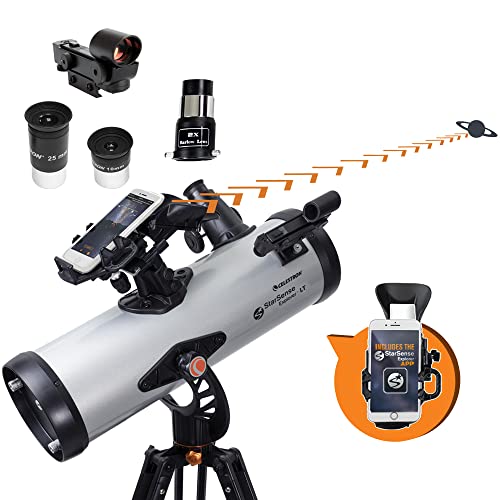
- 1TOP CHOICEBest overallCelestron StarSense Explorer LT 114AZ Newtonian Smartphone Guided TelescopeView on Amazon
- 2
 Best for families with older kidsSVBONY SV48P Telescope for Adults High Powered, 102mm Large Aperture FView on Amazon
- 3
 Best budget pick for kids 8–12Sobrzy Telescope for Kids 8-12, 100x Magnification Beginner Kids TelescopeView on Amazon
Our Top Picks
Quick Comparison
| Product | Best for | Key feature |
|---|---|---|
| Celestron StarSense Explorer LT 114AZ | Beginners who want guided navigation | Smartphone app sky alignment |
| SVBONY SV48P 102mm Refractor | Adults and older teens exploring deep sky | 102mm aperture, f/6.5 focal ratio |
| Sobrzy Kids Telescope 50mm | Kids ages 8–12 on a first telescope | Tripod, two eyepieces, and finder scope included |
Celestron StarSense Explorer LT 114AZ Newtonian Smartphone Guided Telescope
Celestron StarSense Explorer LT 114AZ Newtonian Smartphone Guided Telescope | Smartphone App Sky Navigation, Manual Reflector Telescope, Beginner Deep-Sky Telescope, Bright Celestial Views, Portable
Best for: Beginners who want guided navigation
This model suits people who have never found a faint object in the night sky and want help getting oriented. The smartphone app does the star-matching work, so new observers spend less time guessing and more time looking.
Key specs
- Reflector (Newtonian) optical design
- 114mm aperture as listed in the product name
- Smartphone app sky navigation
- Manual azimuth-altitude mount
Pros
- Smartphone guidance helps locate deep-sky targets quickly
- Large aperture gathers more light than small beginner refractors
- Portable enough for backyard use and short trips
Cons
- Requires a phone and app setup before each session
- Reflectors need occasional alignment checks
Bottom line: A strong first choice for families who want the telescope to find targets with minimal frustration. Adults and teens who enjoy the setup process will likely get the most out of it.
View on AmazonSVBONY SV48P Telescope for Adults High Powered, 102mm Large Aperture F6.5 Achromatic Refractor
SVBONY SV48P Telescope for Adults High Powered, 102mm Large Aperture F6.5 | Short Focal Ratio, Achromatic Refractor OTA, for Beginner Astronomer, Astronomical Telescope for Observation of Deep Space
Best for: Adults and older teens exploring deep sky
This refractor is aimed at observers who want a larger light-gathering opening and are comfortable with a little more hands-on setup. The short focal ratio gives a wide field of view, which helps with larger deep-sky objects.
Key specs
- 102mm objective aperture
- f/6.5 focal ratio
- Achromatic refractor optical tube assembly
Pros
- Large aperture for its class shows more faint detail
- Short focal ratio yields a wide, bright field
- Clean optical design with minimal maintenance
Cons
- Mount and tripod are sold separately or may need upgrading for steady views
- Achromatic optics show some color fringing on bright objects
Bottom line: Best for an older beginner who wants more aperture and is willing to add a sturdy mount. Younger children may find the setup more involved than they need.
View on AmazonSobrzy Telescope for Kids 8-12, 100x Magnification Beginner Kids Telescope
Sobrzy Telescope for Kids 8-12, 100x Magnification Beginner Kids Telescope | 50mm Aperture 400mm Telescope with Tripod, 2 Eyepieces & Finder Scope, Space Toys STEM Educational Gift for Boys & Girls
Best for: Kids ages 8–12 on a first telescope
This kit is built for young observers who need something light, simple, and ready to use out of the box. It includes the accessories a first-time user typically needs, which keeps early sessions fun instead of frustrating.
Key specs
- 50mm aperture, 400mm focal length (per product name)
- Tripod, two eyepieces, and finder scope included
- Up to 100x magnification as listed
Pros
- Complete kit with tripod and eyepieces included
- Lightweight and easy for children to carry and aim
- Designed with young beginners in mind
Cons
- Small aperture limits views of faint deep-sky objects
- High magnification is rarely useful in practice, so expectations should stay realistic
Bottom line: A sensible first telescope for young children who mainly want to see the Moon, bright planets, and star clusters. For dim galaxies, a larger aperture will serve better.
View on AmazonBuying Guide
Aperture
Aperture is the diameter of the main lens or mirror, and it determines how much light the telescope collects. Larger apertures reveal fainter galaxies and nebulae. For deep-sky viewing, aim for at least 100mm if your budget and space allow, and treat smaller instruments as good starters for bright targets.
Good picks for this: SVBONY SV48P, Celestron StarSense Explorer LT 114AZ
Focal ratio
The focal ratio (f-number) compares focal length to aperture. Shorter ratios such as f/6 to f/7 give wider fields of view, which suit large deep-sky objects. Longer ratios produce higher magnification but narrower views that can be harder to track.
Good picks for this: SVBONY SV48P, Sobrzy Kids Telescope 50mm
Mount stability
A wobbly mount makes faint objects almost impossible to hold in view. Check whether the telescope includes a mount and tripod that are rated for the tube weight, and look for a sturdy, adjustable base. Owners often report that a stable mount matters more than a slightly larger aperture.
Good picks for this: Celestron StarSense Explorer LT 114AZ, Sobrzy Kids Telescope 50mm
Ease of setup and navigation
Finding targets is often the hardest part for beginners. Some telescopes include app-based navigation or finder scopes that speed up the process. Consider whether you want to learn the sky manually or would rather be guided, especially if a child will be operating the telescope.
Good picks for this: Celestron StarSense Explorer LT 114AZ, Sobrzy Kids Telescope 50mm
Portability and size
Think about where you will observe. A compact tube is easier to carry to a park or up a dark-sky site, while a larger instrument may stay in the backyard. Weight and storage space both affect how often you will actually use the telescope.
Good picks for this: Sobrzy Kids Telescope 50mm, Celestron StarSense Explorer LT 114AZ
Eyepieces and included accessories
Eyepieces control magnification, and cheap kits sometimes include only low-quality options. Check whether the telescope ships with at least one low-power eyepiece for wide views and one medium-power eyepiece for planets and bright clusters. Accessories like finder scopes also help.
Good picks for this: Sobrzy Kids Telescope 50mm, SVBONY SV48P
Durability and care
Telescopes are used outdoors, so dust, dew, and temperature changes are normal. Refractors need little maintenance, while reflectors may need occasional collimation of the mirrors. Store the telescope indoors when possible, cover the optics between sessions, and let it acclimate to outdoor temperature before observing.
Good picks for this: SVBONY SV48P, Celestron StarSense Explorer LT 114AZ
FAQ
What is the best beginner deep space telescope for a child?
For children roughly 8 to 12, a lightweight kit with a tripod and simple eyepieces is usually the easiest start. The Sobrzy Kids Telescope 50mm is built with that age group in mind, though it will show brighter targets more clearly than faint galaxies.
Do I need a large aperture to see deep-sky objects?
Larger apertures collect more light and reveal fainter objects, but a smaller telescope can still show star clusters, the Moon, and bright planets. Many beginners find that dark skies matter as much as aperture.
Is a reflector or refractor better for deep-sky viewing?
Both can work well. Reflectors generally offer more aperture for the money, while refractors need less maintenance and rarely need collimation. Your choice depends on how much setup you want to handle.
How much magnification do I need?
Lower magnification gives wider, brighter views that are easier to find and enjoy. High magnification is useful only when the air is steady and the object is bright enough to hold up. Be cautious of any product that advertises very high magnification as its main feature.
Do I need a phone app to find objects?
No, but an app can make navigation much faster for beginners. Star charts and a simple planisphere also work well, and learning the constellations by sight builds useful skills over time.
Where should I observe from?
Dark sites away from city lights show far more deep-sky detail. Even a backyard can work if you wait for moonless nights and let your eyes adjust for about 20 minutes.
Is a telescope suitable for very young children?
Supervision is important, especially around setup and any sun observation, which should never be attempted with an unfiltered telescope. Consult a parent or qualified adult before letting a child operate equipment outdoors at night.
Conclusion
For most beginners who want guided help finding targets, the Celestron StarSense Explorer LT 114AZ is a practical starting point. Adults and older teens who want more light and a wider field may prefer the SVBONY SV48P, provided they plan for a sturdy mount. For younger children, the Sobrzy Kids Telescope 50mm offers a complete, easy-to-use kit for learning the sky. Match the telescope to the observer’s age, patience with setup, and the kind of targets they most want to see.
Sources
- Current night-sky events, planet visibility, and space science education resources (nasa.gov)
- Beginner observing guides and amateur astronomy education materials
- Information on astronomy education, outreach, and dark-sky awareness
Related reading
- Best Beginner Telescope for Deep Space: 5 Things to Check Before You Buy
- 6 Best Beginner Telescopes for Deep Space Viewing: Picks Compared (2026)
- Bushnell Deep Space 150 X 50mm Refractor Telescope: A Family Guide
- Which Telescope Should I Buy as a Beginner? 5 Factors That Matter (2026)
- Terraen 50x 100x Refractor Telescope: A Beginner's Guide for Families
- Telescope 80eq Refractor Scope: A Beginner's Guide for Families (2026)
About Caleb Morgan
Caleb Morgan is part of our editorial team and reviews and edits our astronomy for kids, teens & families guides, checking product details against manufacturer specifications and owner feedback.
About the author
Caleb Morgan writes reviews and buying guides for Youth in Astronomy.