6 Best Deep Space Refractor Telescope Picks for Families in 2026
Compare 6 deep space refractor telescope options for families, with key specs, pros, cons and buying tips to help you pick the right scope for your night sky.
 By Owen Palmer
Updated November 25, 2026
 By Owen Palmer
Updated November 2026
Families who want to see star clusters, nebulae and galaxies often start their search for a deep space refractor telescope and quickly find dozens of similar-looking boxes with big numbers on the side. This list narrows the field to six options that fit common family needs. The selection method is research-based: we looked at published specifications, brand reputation and the patterns owners tend to describe in their feedback, with a focus on aperture, mount type, ease of setup, portability and how well each model suits young beginners. We did not test these telescopes ourselves, so treat the notes below as a guide to what each design is built for rather than a record of hands-on results.
Our top picks at a glance
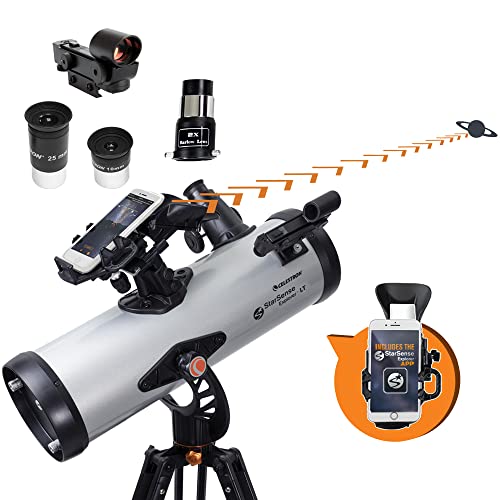
- 1TOP CHOICEBest overallCelestron StarSense Explorer LT 114AZ Newtonian Smartphone Guided TelescopeView on Amazon
- 2
 TOP CHOICEBest for first-time familiesCelestron Travel Scope 80mm Telescope Kit with Backpack, Smartphone AdapterView on Amazon
- 3
 TOP CHOICEBest for high magnificationGskyer Telescope 600x90mm AZ Astronomical Refractor Telescope for AdultsView on Amazon
- 4Best for wide-field deep skyGskyer Telescope 600x90mm AZ Astronomical Refractor Telescope for AdultsView on Amazon
- 5
 Best for serious beginnersSVBONY SV550 Triplet APO Telescope, 122mm F7 ED Glass Telescope for AdultsView on Amazon
- 6
 Best budget pickBushnell Refractor 600x50mm Telescope, Deep Space Viewing Telescope 181561View on Amazon
Quick note on what to look for: A deep space refractor telescope gathers light through a lens rather than a mirror. For faint objects like galaxies, aperture (the lens diameter) matters more than magnification. Larger apertures show more detail, but they also cost more to carry and need steadier mounts.
Our Top Picks
Quick Comparison
| Product | Best for | Key feature |
|---|---|---|
| Celestron StarSense Explorer LT 114AZ | Best overall | Smartphone app sky navigation |
| Celestron Travel Scope 80mm Telescope Kit | Best for first-time families | Backpack and smartphone adapter included |
| Gskyer Telescope 600x90mm AZ | Best for high magnification | 90mm aperture on an alt-azimuth mount |
| SVBONY SV48P Telescope | Best for wide-field deep sky | 102mm aperture at a short f/6.5 focal ratio |
| SVBONY SV550 Triplet APO Telescope | Best for serious beginners | 122mm triplet apochromatic optics |
| Bushnell Refractor 600x50mm Telescope | Best budget pick | Simple setup for quick sessions |
Celestron StarSense Explorer LT 114AZ Newtonian Smartphone Guided Telescope
Celestron StarSense Explorer LT 114AZ Newtonian Smartphone Guided Telescope | Smartphone App Sky Navigation, Manual Reflector Telescope, Beginner Deep-Sky Telescope, Bright Celestial Views, Portable
Best for: Best overall
This model suits families who want help finding targets. A smartphone app guides the telescope to objects, which removes much of the frustration new observers feel when they cannot locate anything in the eyepiece. Note that this is a Newtonian reflector rather than a refractor, so it is included here as an alternative for families who want guided deep-sky viewing.
Key specs:
- Aperture: 114mm
- Design: Newtonian reflector on an alt-azimuth mount
- Navigation: smartphone app sky guidance
Pros:
- App-guided sky navigation helps beginners find targets quickly
- Large aperture gathers good light for deep-sky objects
- Owners often describe setup as straightforward
Cons:
- Requires a smartphone and app to get the full guided experience
- Reflector optics need occasional collimation (mirror alignment)
Bottom line: A strong choice for families whose kids want quick wins finding objects, especially if a phone app feels like a natural fit.
View on AmazonCelestron Travel Scope 80mm Telescope Kit with Backpack, Smartphone Adapter
Celestron Travel Scope 80mm Telescope Kit with Backpack, Smartphone Adapter | 80mm Refractor Telescope Kit, Large Lens for Planets & Deep-Sky, Includes Smartphone Adapter & Backpack, Beginner-Friendly
Best for: Best for first-time families
Families who plan to move the telescope between the backyard, a campsite or a school event will appreciate the included backpack. The 80mm refractor design is easy to carry and gives a gentle introduction to viewing the Moon, planets and brighter deep-sky targets.
Key specs:
- Aperture: 80mm refractor
- Includes backpack and smartphone adapter
Pros:
- Light enough for kids to carry with a backpack
- Smartphone adapter makes photos of the Moon easy
- Refractor optics require no collimation
Cons:
- 80mm aperture shows fainter deep-sky objects with less detail
- Accessories are basic, so upgrades may be needed later
Bottom line: Best for families who want a portable, low-fuss starter kit that works for trips as well as home use.
View on AmazonGskyer Telescope 600x90mm AZ Astronomical Refractor Telescope for Adults
SVBONY SV48P Telescope for Adults High Powered, 102mm Large Aperture F6.5 | Short Focal Ratio, Achromatic Refractor OTA, for Beginner Astronomer, Astronomical Telescope for Observation of Deep Space
Best for: Best for high magnification
This model is aimed at families with older teens or adults who want to push magnification. The 90mm aperture is a step up from smaller starter scopes, and the alt-azimuth mount keeps the setup simple for quick nighttime sessions.
Key specs:
- Aperture: 90mm refractor
- Mount: alt-azimuth (AZ)
- Advertised maximum magnification: 600x
Pros:
- Larger aperture than many starter refractors
- Alt-azimuth mount is intuitive for beginners
- Good for planetary detail as well as deep sky
Cons:
- High advertised magnification is rarely usable in practice; sharpness depends on sky conditions
- Included eyepieces may need upgrading for best views
Bottom line: Suits families who want more aperture on a budget and are willing to learn to use mid-range magnification effectively.
View on AmazonSVBONY SV48P Telescope for Adults High Powered, 102mm Large Aperture F6.5
Best for: Best for wide-field deep sky
A short focal ratio such as f/6.5 produces a wide field of view, which helps when scanning the Milky Way or framing large nebulae. Families who enjoy sweeping the sky rather than zooming into single targets often prefer this kind of design.
Key specs:
- Aperture: 102mm
- Focal ratio: f/6.5
- Design: achromatic refractor optical tube assembly (OTA)
Pros:
- Wide field suits sweeping the Milky Way and large nebulae
- Large aperture gathers plenty of light for deep-sky targets
- Compact focal ratio keeps the tube relatively short
Cons:
- Sold as an optical tube, so a mount and tripod are needed separately
- Achromatic optics can show slight color fringing on bright objects
Bottom line: A good fit for families who already have a sturdy mount or are ready to build a more capable setup.
View on AmazonSVBONY SV550 Triplet APO Telescope, 122mm F7 ED Glass Telescope for Adults
SVBONY SV550 Triplet APO Telescope, 122mm F7 ED Glass Telescope for Adults | 2.5" Dual-Speed Focuser, 87mm Focus Travel Distance, Refractor Telescope High Power, for Deep Space Astrophotography Visual
Best for: Best for serious beginners
Families whose young astronomers have moved past basic scopes may want to step up to triplet apochromatic optics. The ED glass elements aim to reduce color fringing, and the dual-speed focuser makes fine focusing easier, which matters for deep-sky work.
Key specs:
- Aperture: 122mm
- Focal ratio: f/7
- Optics: triplet apochromatic with ED glass
- Focuser: 2.5-inch dual-speed, 87mm travel distance
Pros:
- ED glass optics help reduce color fringing
- Dual-speed focuser allows precise focusing
- Large aperture rewards careful observing with rich detail
Cons:
- Heavier and more demanding on the mount than entry-level scopes
- Higher level of complexity may overwhelm very young beginners
Bottom line: Best for families with a teen or adult who is committed to the hobby and wants optics that can grow with them.
View on AmazonBushnell Refractor 600x50mm Telescope, Deep Space Viewing Telescope 181561
Bushnell Refractor 600x50mm Telescope, Deep Space Viewing Telescope 181561
Best for: Best budget pick
Bushnell is a well-known name in optics, and this refractor is aimed at families who want a simple, no-frills telescope for occasional backyard viewing. It works well for the Moon and bright planets, and it gives younger children an easy first look at the night sky.
Key specs:
- Design: refractor
- Advertised magnification: 600x with 50mm aperture
Pros:
- Simple setup suits quick evening sessions
- Recognizable brand with broad availability
- Refractor design needs no mirror alignment
Cons:
- 50mm aperture limits how much faint deep-sky detail is visible
- Advertised 600x magnification is rarely useful at this aperture
Bottom line: A reasonable entry point for families who want to see whether a telescope hobby holds their child’s interest before spending more.
View on AmazonBuying Guide
Aperture and Light Gathering
Aperture, the diameter of the main lens, is the single most important number for deep-sky viewing. Larger apertures collect more light, which makes faint galaxies and nebulae easier to see. A 50mm lens shows far less than a 100mm lens under the same sky. Plan for at least 80mm if galaxies are the main goal.
Good picks for this: SVBONY SV48P, SVBONY SV550 Triplet APO
Focal Ratio and Field of View
The focal ratio (f-number) controls how wide the view is. A low number such as f/6.5 gives a wide, bright field that suits sweeping the Milky Way. Higher numbers give narrower views with more magnification. Match the focal ratio to what your family most wants to see.
Good picks for this: SVBONY SV48P, Gskyer Telescope 600x90mm AZ
Mount Type and Stability
Many starter refractors use an alt-azimuth mount, which moves up-down and side-to-side. It is intuitive, but tracking objects as Earth rotates takes manual nudging. Equatorial mounts track more smoothly but are harder to learn. A wobbly mount frustrates beginners more than a small aperture does.
Good picks for this: Gskyer Telescope 600x90mm AZ, Celestron StarSense Explorer LT 114AZ
Ease of Setup and Guidance
Setup time decides whether a telescope gets used. Look for quick-assembly designs and features that help people find objects, such as smartphone app guidance. Families with young children often succeed more with guided systems than with purely manual scopes.
Good picks for this: Celestron StarSense Explorer LT 114AZ, Celestron Travel Scope 80mm Telescope Kit
Portability and Storage
Think about where the telescope will live. A backyard scope can be bulky, but a telescope that will go on car trips needs a case or backpack and a lighter tube. Check the weight of the tube and mount together, since heavy setups are harder for kids to carry safely.
Good picks for this: Celestron Travel Scope 80mm Telescope Kit, Bushnell Refractor 600x50mm Telescope
Optical Quality and Color Correction
Achromatic refractors can show slight color fringing around bright objects, while apochromatic designs with ED glass reduce this effect. Fringing matters most when viewing the Moon and planets. Budget scopes often accept some fringing as a tradeoff for lower cost.
Good picks for this: SVBONY SV550 Triplet APO, SVBONY SV48P
Care and Maintenance
Refractor optics are sealed and rarely need adjustment, which suits families. Keep dust caps on when not in use, store the scope indoors to avoid condensation, and let the tube reach outside temperature before observing. Reflector designs need occasional collimation, so factor that into your upkeep plans.
Good picks for this: Celestron Travel Scope 80mm Telescope Kit, Bushnell Refractor 600x50mm Telescope
FAQ
What is a deep space refractor telescope?
A deep space refractor telescope uses a main lens to gather light from faint objects such as galaxies, nebulae and star clusters. Refractors are sealed and generally low-maintenance, which makes them popular with families.
How big of an aperture do I need for deep-sky objects?
Many beginners find that 80mm or larger gives satisfying views of brighter deep-sky targets. Smaller apertures can still show star clusters and the Moon well, but galaxies and faint nebulae are harder to see.
Is more magnification always better?
No. Magnification only helps when the image stays sharp, and that depends on aperture, optical quality and sky conditions. Advertised maximum magnification numbers are often higher than what a telescope can use well.
Do refractors need collimation?
Standard refractors do not need collimation because the lens is sealed in the tube. Reflectors, such as Newtonian designs, use mirrors that may need periodic alignment.
Can kids use a deep space refractor telescope on their own?
Many kids can operate simpler models with some help, especially guided or alt-azimuth designs. Supervision is wise for setup, carrying heavy parts and any work near the sun. Never point a telescope at the Sun without a proper solar filter, as direct sunlight can cause permanent eye damage.
Where can I learn more about safe telescope use?
Organizations that publish astronomy education and observing safety information are a good starting point. The sources below offer background reading for families.
Conclusion
For most families, the Celestron StarSense Explorer LT 114AZ offers the easiest path to finding targets, while the Celestron Travel Scope 80mm Telescope Kit suits those who need portability. Families who want more aperture should look at the Gskyer Telescope 600x90mm AZ or the SVBONY SV48P, depending on whether they prefer high magnification or a wide field. Committed teens and adults may find the SVBONY SV550 Triplet APO worth the step up, and the Bushnell Refractor 600x50mm Telescope is a modest starting point for a trial hobby. Match the aperture, mount and portability to how your family will actually observe, and the right deep space refractor telescope will be the one you use most often.
Sources
- Background on telescopes, the night sky and space science for family learning (nasa.gov)
- Guidance and education resources from the Astronomical League for amateur observers
- Information on astronomy education and public outreach from the American Astronomical Society
Before you buy: helpful guides
Related reading
- 6 Best Beginner Telescopes for Deep Space Viewing: Picks Compared (2026)
- 3 Best Beginner Deep Space Telescope Picks for 2026
About Owen Palmer
Owen Palmer is part of our editorial team and reviews and edits our astronomy for kids, teens & families guides, checking product details against manufacturer specifications and owner feedback.
About the author
Owen Palmer writes reviews and buying guides for Youth in Astronomy.