6 Best Long Focal Length Refractor Telescopes for Beginners (2026)
Compare 6 long focal length refractor telescope options for families and beginners, with focal length, aperture, mount and setup notes to help you choose.
 By Owen Palmer
Updated November 25, 2026
 By Owen Palmer
Updated November 2026
Shopping for a long focal length refractor telescope can feel confusing, because the numbers on the box rarely tell you what you will actually see through the eyepiece. This guide compares six beginner-friendly refractors with long focal lengths, which usually means 400mm to 900mm in this size class. We looked at published specifications, the mount and accessories each kit includes, how well the setup suits children and first-time observers, and the patterns owners tend to mention in their feedback. Our goal is to help you match a telescope to what your family actually wants to look at.
Our top picks at a glance
- 1TOP CHOICEBest overallNational Geographic Sky View 70mm Refractor Telescope with Panhandle MountView on Amazon
- 2
 TOP CHOICEBest for travelTelescopes, Telescope for Kids and Adults Beginners, 70mm Aperture 400View on Amazon
- 3
 TOP CHOICEBest for hands-off viewingTelescope for Adults, Kids & Beginners, 70mm Refractor, 4.5" LCD DisplayView on Amazon
- 4
 Best for planets and the Moon90mm Aperture Telescope 800mm Focal Length Refractor for Beginners & AdultView on Amazon
- 5
 Best for steady mountingTelescope for Adults, 90mm/900mm Vertisteel AZ Refractor, WhiteView on Amazon
- 6
 Best budget pick with extrasFeicosky Telescope for Adults & Kids High Powered 90mm Aperture 600mmView on Amazon
Our Top Picks
Quick Comparison
| Product | Best for | Key feature |
|---|---|---|
| National Geographic Sky View 70mm | Families starting out | 400mm focal length with panhandle mount |
| Travel Refractor 70mm 400mm | Portable observing | Lightweight AZ mount for trips |
| 70mm Refractor with 4.5″ LCD | Kids who want to share the view | LCD display and wireless remote |
| 90mm 800mm Refractor | Planets and the Moon | 800mm focal length and 3x Barlow lens |
| Vertisteel AZ 90mm/900mm | Steady high-magnification viewing | 900mm focal length on AZ mount |
| Feicosky 90mm 600mm Kit | All-in-one starter kit | 600mm focal length with carry bag and stool |
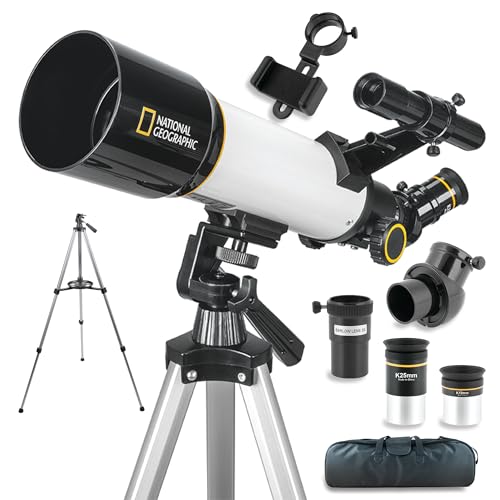
National Geographic Sky View 70mm Refractor Telescope with Panhandle Mount
National Geographic Sky View 70mm Refractor Telescope with Panhandle Mount | 400mm focal length, 2 eyepieces, 3x Barlow lens, smartphone adapter, beginner astronomy for kids and adults
Best for: Families starting out with a first telescope
This kit suits parents who want a straightforward setup that children can operate with a little guidance. The panhandle mount keeps the tube steady and makes it easy to point at the Moon, bright planets and star clusters without fussing over alignment.
Key specs
- 70mm aperture
- 400mm focal length
- Two eyepieces and a 3x Barlow lens
- Smartphone adapter
Pros
- Simple, familiar layout that is easy to learn
- Panhandle mount is stable for its size
- Includes eyepieces and a Barlow lens so you can change magnification right away
Cons
- A 70mm aperture gathers less light than 90mm models, so faint objects are harder to see
- Smartphone photography takes patience and a steady hand
Bottom line: A good choice for a family that wants a dependable first refractor and plans to view mostly the Moon and bright planets.
View on AmazonTelescopes, Telescope for Kids and Adults Beginners, 70mm Aperture 400mm Focus Length Refractor Travel Telescope with AZ Mount
Telescopes, Telescope for Kids and Adults Beginners, 70mm Aperture 400mm Focus Length Refractor Travel Telescope with AZ Mount for Observe The Moon and Landscape
Best for: Portable observing on trips and camping weekends
This model is built around portability. The AZ mount and compact tube make it practical to carry to a park, a cabin or a relative’s backyard, and it works well for lunar and landscape viewing.
Key specs
- 70mm aperture
- 400mm focus length
- AZ (altitude-azimuth) mount
Pros
- Light enough to carry in one hand
- Quick to set up and pack away
- Suitable for daytime landscape viewing as well as night use
Cons
- Smaller aperture limits deep-sky performance
- Lighter mounts can wobble at high magnification
Bottom line: Best for families who want a telescope that travels easily and mainly views the Moon and nearby landmarks.
View on AmazonTelescope for Adults, Kids & Beginners, 70mm Refractor, 4.5″ LCD Display
Telescope for Adults, Kids & Beginners, 70mm Refractor, 4.5" LCD Display | No Phone Needed, 400mm Focal Length, Coated Optics, Wireless Remote, 25mm Eyepiece, Easy Setup, Complete Kit & Moon Viewing
Best for: Kids who want to share the view without crowding the eyepiece
The LCD display lets several people watch the same target at once, which can be a real advantage with young children who get impatient waiting for a turn at the eyepiece. The wireless remote adds convenience for changing targets.
Key specs
- 70mm refractor optics
- 400mm focal length
- 4.5-inch LCD display
- Wireless remote and 25mm eyepiece
Pros
- Shared display makes group viewing easier
- Wireless remote reduces touching the tube
- Complete kit for a fast start
Cons
- Display viewing is not the same as a direct eyepiece experience
- Battery use will need to be managed on long sessions
Bottom line: A strong pick for family groups where several children want to see the same object at the same time.
View on Amazon90mm Aperture Telescope 800mm Focal Length Refractor for Beginners & Adult
90mm Aperture Telescope 800mm Focal Length Refractor for Beginners & Adult, Professional Astronomy Telescope with 32X-240X Magnification, 3X Barlow Lens & Phone Adapter
Best for: Planets and the Moon at higher magnification
An 800mm focal length with a 90mm aperture gives plenty of magnification range for lunar craters and bright planetary detail. This suits older kids and adults who are willing to spend a few minutes on alignment.
Key specs
- 90mm aperture
- 800mm focal length
- Magnification range listed as 32x to 240x
- 3x Barlow lens and phone adapter
Pros
- Larger aperture than 70mm models gathers more light
- Wide magnification range for planets and the Moon
- Barlow lens included
Cons
- Magnification numbers on the box are often optimistic; useful views top out much lower
- Requires a sturdy surface to avoid vibration
Bottom line: A good fit for families focused on the Moon and planets who will set up the telescope on a stable table or tripod.
View on AmazonTelescope for Adults, 90mm/900mm Vertisteel AZ Refractor, White
Telescope for Adults, 90mm/900mm Vertisteel AZ Refractor, White | Long-focus 90mm refractor for Moon and planet viewing, with Vertisteel AZ mount, phone adapter and wireless remote.
Best for: Steady, high-magnification views of the Moon and planets
The 900mm focal length gives a long, narrow field of view that rewards careful focusing. The Vertisteel AZ mount is designed to keep the tube stable enough for these longer optics.
Key specs
- 90mm aperture
- 900mm focal length
- Vertisteel AZ mount
- Phone adapter and wireless remote
Pros
- Long focal length suits detailed lunar views
- Stable AZ mount for its class
- Wireless remote helps with fine control
Cons
- Narrow field of view makes finding objects harder for beginners
- Heavier than travel models
Bottom line: Best for families who plan to stay in one place and spend time on the Moon and planets.
View on AmazonFeicosky Telescope for Adults & Kids High Powered 90mm Aperture 600mm
Feicosky Telescope for Adults & Kids High Powered 90mm Aperture 600mm | Refractor telescope kit for beginners, moon, stargazing, phone adapter, carry bag, folding stool and holiday stickers.
Best for: A complete starter kit with accessories included
This kit bundles a 90mm refractor with a carry bag, folding stool, phone adapter and holiday stickers, which makes it appealing as a gift. The 600mm focal length offers a balance between field of view and magnification.
Key specs
- 90mm aperture
- 600mm focal length
- Phone adapter, carry bag and folding stool
Pros
- Accessories are included, so there is less to buy later
- Carry bag and folding stool make outings easier
- Shorter focal length than 800mm and 900mm models gives a wider view
Cons
- Accessory quality varies, and owners often replace the included eyepieces
- Specific mount details should be checked against the listing before purchase
Bottom line: A practical gift-ready choice for families who want everything in one box.
View on AmazonBuying Guide
Focal length and magnification
Focal length is the distance light travels inside the telescope before it reaches the eyepiece. A longer focal length generally produces higher magnification with a given eyepiece, but it also narrows the field of view. For a first telescope, a focal length between 400mm and 900mm is typical for refractors in this size class. Remember that the maximum useful magnification is usually about 50 times the aperture in millimeters under good conditions, so a 70mm telescope rarely delivers useful views much beyond about 140x.
Good picks for this: Vertisteel AZ 90mm/900mm, 90mm 800mm Refractor
Aperture
Aperture is the diameter of the main lens. Larger apertures gather more light, which helps with fainter objects and sharper planetary detail. Moving from 70mm to 90mm is a noticeable step up in light-gathering, though both are modest by amateur standards.
Good picks for this: 90mm 800mm Refractor, Feicosky 90mm 600mm Kit
Mount type and stability
The mount matters as much as the optics. An AZ mount moves up-down and side-to-side, which is intuitive for beginners. Long focal lengths magnify every vibration, so a wobbly mount will frustrate you at high power. Look for a sturdy tripod and a mount that locks firmly.
Good picks for this: National Geographic Sky View 70mm, Vertisteel AZ 90mm/900mm
Portability and size
Think about where you will observe. A heavier telescope on a long tripod is fine for a backyard, but it is harder to carry to a park. Check the tube length and weight before buying, especially if children will be carrying it.
Good picks for this: Travel Refractor 70mm 400mm, Telescope 4.5″ LCD Display 70mm
Ease of use for children
Young observers often benefit from shared displays, wireless remotes and simple focusing. If several kids want to look at the same target, a display model can reduce arguments over the eyepiece.
Good picks for this: Telescope 70mm Refractor with 4.5″ LCD, National Geographic Sky View 70mm
Included accessories
Eyepieces, Barlow lenses, smartphone adapters and carry cases all affect how quickly you can start. Kits that include these items save you from buying them separately, though the included parts are often basic. Plan to upgrade the eyepieces later if you find you use the telescope often.
Good picks for this: Feicosky 90mm 600mm Kit, 90mm 800mm Refractor
Setup and care
Store the telescope in a dry place, keep the lens caps on when not in use, and avoid touching the glass with bare fingers. Clean lenses only with a soft brush or microfiber cloth. Setup takes a few minutes, so plan a short practice session in daylight before your first night outside.
Good picks for this: Travel Refractor 70mm 400mm, National Geographic Sky View 70mm
FAQ
What is a long focal length refractor telescope good for?
Long focal length refractors are generally well suited to the Moon, bright planets such as Jupiter and Saturn, and double stars. The long focal length produces higher magnification with common eyepieces, which helps reveal surface detail. They are less ideal for wide views of large deep-sky objects, where a shorter focal length works better.
Is 400mm focal length enough for a beginner?
Yes, for many families. A 400mm focal length provides a wider field of view that makes it easier to find objects, and it still delivers good views of the Moon. Longer focal lengths offer more magnification but are harder to aim.
Does aperture matter more than focal length?
Aperture determines how much light the telescope gathers and how sharp the image can be at high power. Focal length mainly sets magnification and field of view. For planets and the Moon, a larger aperture is usually more important than a very long focal length.
Can a long focal length refractor show galaxies and nebulae?
Some of the brightest objects, such as the Orion Nebula and the Andromeda Galaxy, can be seen with a 70mm or 90mm refractor from a dark site. Fainter galaxies and nebulae usually require larger apertures and darker skies than most beginner kits provide.
Do I need a Barlow lens?
A Barlow lens increases magnification of the eyepiece by a set factor, such as 2x or 3x. It can be useful with long focal lengths, but it reduces brightness and image quality slightly. Many beginners find that a good set of standard eyepieces is enough at first.
Is a refractor better than a reflector for kids?
Refractors have sealed tubes that need little maintenance and tend to give crisp views of the Moon and planets. Reflectors often offer more aperture for the money but may need collimation. Your choice depends on what you want to observe and how much maintenance you want to handle.
Should I buy a telescope kit or pieces separately?
Kits are convenient for beginners because the telescope, mount and basic accessories are matched and ready to use. Separate purchases allow more control over quality but require more research. For most families, a kit is the simplest place to start.
Conclusion
For most families, the National Geographic Sky View 70mm is a sensible starting point, while the Travel Refractor 70mm suits people who need portability. Choose the 70mm LCD model if several children want to share the view, and the 90mm 800mm refractor if planets and the Moon are the priority. The Vertisteel AZ 900mm rewards patient observers who can stay in one place, and the Feicosky 600mm kit works well as a gift with accessories included. Match the telescope to where you will observe and who will use it, and you will get more out of your first nights under the stars.
Sources
- Background on the Moon, planets and how telescopes reveal them (nasa.gov)
- Guidance on dark-sky viewing and stargazing at national park sites (nps.gov)
- Educational resources on telescope types and observing basics
Before you buy: helpful guides
- Long Focus Refractor Telescope: 6 Steps to Choose and Use One (2026)
- Telescope Reflector or Refractor: How to Choose the Right One for Your Family
- How Do You Explore Scientific Refractor Telescope Skies? A Beginner's Guide
- 70mm Refractor Telescope for Beginners: What to Know Before You Buy
- Celestron Starsense Explorer Dx 102az Refractor Telescope: A Practical Guide (2026)
Related reading
- Refractor Telescope vs Reflector Review: Who Is It For?
- 3 Best Vivitar Refractor Telescopes with Tripod Picks for Families (2026)
About Owen Palmer
Owen Palmer is part of our editorial team and reviews and edits our astronomy for kids, teens & families guides, checking product details against manufacturer specifications and owner feedback.
About the author
Owen Palmer writes reviews and buying guides for Youth in Astronomy.